Wednesday, April 18, 2012

Playtime for Qannik


My early April visit to the Louisville Zoo brought me face-to-face with 15 month old Qannik. No longer the fluffy little baby bear I met last fall, Qannik is still just as cute as can be, but weighing over 250 pounds. Her life in the Louisville Zoo is helping her to grow up to be a happy and healthy polar bear. She was rescued in Alaska last year, starving, motherless, and weighing only 15 pounds. After spending several months being pampered at the Alaska Zoo, she flew to Louisville to begin her new life.

The Louisville Zoo believes in making life interesting for its bears. Polar Bears and Grizzly Bears in the wild live in an ever-changing world, and this zoo is shaking things up to make life fun and unpredictable in a number of ways.


For one thing, the bears are rotated in and out of the two exhibit areas several times a day, spending some time in their bedrooms, and some time in the big pool area, and some time in the “loading dock” area. Glacier Run is designed to look like an abandoned mining town, with the interesting features often doing double duty as bear enrichment and exercise equipment.


And the staff always considers what is best for the bears, not necessarily what is best for the public. When Qannik, and then later Siku, first arrived, it was slow going, allowing each bear to adjust to the new environment. When it was time for Qannik to make her debut, she had the run of the glassed-in room, but it was covered with papers so she could get used to the new material. The posters were slowly removed over a period of weeks so she could slowly adjust easily to having her fans invited into her life. The same process has applied to Siku. He is now occasionally in the glassed in room, and will soon be in the big swim area. At this zoo, the big question is “What is best for the bears?”


Qannik spends 80 percent of her time in the pool when she is in the larger enclosure. She uses her natural hunting instincts to stalk her buckets and balls, and jump on her pretend ice floe.


When she is in the loading dock “playroom” area she often plays in the pools full of water or ice. When it snowed over the winter, staffers filled up her pool with ice and packed snow on top of it. She loved that.


Sometimes the keepers feed her meat snacks on a stick through the fencing in the upstairs crossover of Bear Alley. While she was enjoying her tidbits, the crowd below was enthralled by her guttural response. The noises she makes are startlingly monstrous, kind of a low and loud growl. It's hard to believe that such scary noises are coming from such a cute little snowball of a bear.

Qannik used to take a break at lunchtime for a nap, but her keepers say that she now pretty much keeps going all day, with only a few brief moments to rest. 


The keepers watcher her constantly, with a clipboard in hand, documenting her activities and how much time she spends doing whatever she is doing, and where. They also test “poop” samples every day for stress hormones, to make sure the bears are happy.


Qannik responds whenever she hears the voice of one of her keepers, thinking that they might have something for her. But she pretty much is oblivious to her fans. She does whatever she feels like doing, ignoring all her visitors.


 When she is in the big pool area, she dives and swims and plays with her toys, taking a break every once in a while to run over to the door that she knows Arki is behind to scratch at it. She loves to run up and down the ramp, too.


When she is in the loading dock area, she runs up and down those stairs, and checks out the overhead crossing. She jumps up into the back of the “truck” to check for hidden treats. There was a little bird in the hay and she tried to catch it. The keepers say that although she does try to catch the occasional bird, she never really succeeds. The door to her downstairs bedroom is open so she has the choice to rest down there. Louisville Zoo Director John T. Walczak explained to me that when the doors are closed, the doors become a focal point of interest and stress. When the bears have a choice because the doors are open, they are less stressed. It is all about giving the bears a choice. He is also a great proponent of the rotating schedule, which gives the bears variety and the unpredictability they would have in the wild.


 I suspect the keepers lose sleep thinking of new ways to surprise the bears. They hide food in tied up jute sacks. Snacks are hidden in plastic pails with lids. Treats are lurking under piles of hay, but the bears can find them with their strong sense of smell. 

 Sometimes treats are hidden in doggie Kongs. I saw that Qannik's environment was changed up several times in an afternoon. Barricades were put up to challenge her. Snacks were hidden. New ice tubs were put out. Toys were switched out. There was always something new for this busy little girl.

Qannik


 Behind the scenes, Siku was getting the same treatment in his luxury condo with a swimming pool. Grandma Arki and the Grizzly Bear family also have lots to do to exercise their minds and strengthen their bodies. There is never a dull moment for the bears at the Louisville Zoo.

Qannik

Because Qannik is being raised in this exciting environment from a very young age, the hope is that she will not develop the stereotypical pacing behavior often seen in older zoo bears such as Arki. Even 27 year old Arki is benefiting from the new activities and rotating schedule at the Louisville Zoo, although she will always do her habitual little “dance.” More on Arki later.

Qannik


Friday, April 13, 2012

Splashing with Qannik

She just never stops moving. Little 15 month old Qannik, now at 253 pounds, is a little dynamo at Glacier Run at the Louisville Zoo. And when she is in the big habitat, she spends 80 percent of her time in the pool. The keepers keep track of her activity, moment to moment, and by far and away, she likes to spend her time swimming and diving.


Of course she has a grand time wherever she is. When she is in the smaller habitat, she never stops having fun. She runs up and down the stairs, and finds new and exciting ways to play with all her toys. The keepers are always hiding surprises for her too, as enrichment. And she likes playing in tubs of water and ice in the smaller habitat as well. But give her the big pool, and she is an Olympic swimmer and diver.

Here she is swimming with her favorite green horse ball that she got for her first birthday in January.


Buckets make great swim toys, even if they are a little bit used. She looks a little like an Angel here.


 She looks smaller in the water, but when she gets out, you can see how much she has grown. When Qannik was found abandoned in an oilfield in Alaska last spring, she only weighed 15 pounds. After being rescued, she lived at the Alaska Zoo for several months where she put on some pounds and made many friends, and then found a new home in Glacier Run at the Louisville Zoo in late June.


A view of Qannik's "water park"

An ice floe that never melts.


All this activity burns up a lot of calories! Qannik gets three main meals a day, consisting of meat, fish and polar bear biscuits, and bowls of polar bear milk formula. She also spends her time discovering treats hidden around her enclosure, in buckets, in jute bags, buried in hay and in other secret spots. She loves solving puzzles when it means she gets another snack. The keepers are always thinking up new ways to surprise this little girl bear.


Even in the smaller area, Qannik is never far from a tub of water or ice. Here she is with one of her many adoring fans.

That's Qannik, the pool girl at play.


Because the Louisville Zoo has three polar bears that have to be 
kept separate for now, and a family group of three grizzly bears, 
the zoo has an ever-changing rotation schedule, so Qannik 
moves around during the day. This variety of environments also 
is good for the bears, so they always have something new to do.

I will write more later about Siku and his grandmother Arki, and also about how the zoo staff keeps the environment exciting for all the bears. Also, more pictures of Qannik.

Wednesday, April 4, 2012

Vilma – Motherhood at last.

Vilma of  Zoo Wuppertal in Germany


Although this blog is mainly about polar bears in zoos in the USA, I will occasionally include some international polar bear stories.

In the past four years, there has only been one polar bear cub born in a United States Zoo. That is Siku, born two years ago to Crystal and Marty at the Toledo Zoo in Ohio. Last year, little wild Qannik, an abandoned cub, was rescued in Alaska. Both cubs are now living at the Louisville Zoo.

There is also a new cub in the Toronto Zoo this year, cute little Hudson. The St. Felicien Twins a couple of years ago in Quebec also stirred the hearts of polar bear lovers.


But we do have polar bear cub news out of Europe. Here we go on a detour to Germany, to celebrate the news from Zoo Wuppertal in Germany about the debut of little 3 month old cub Anori, daughter of Vilma and Lars.

With the birth of her daughter on January 4, 2012, ten year old Vilma finally gets a chance at happiness. Anori was born and took her first steps in the special mother-and-cub habitat at Zoo Wupperal. The world has really taken notice of this little lady. Her first pictures and videos are everywhere. Anori is remarkable not only for her cuteness, but also because she is the half-sister of the late Knut of the Berlin Zoo, who died just about a year ago at age 4. Knut was the world's most famous polar bear.

Here is a link to Anori's debut on March 29. Mom Vilma is very protective of her little daughter.


Last Spring

These following pictures are from last spring, when I visited Vilma and Lars at Zoo Wuppertal on a rainy day in May, shortly after the end of polar bear mating season. On the day I visited, the two bears were getting along, but not interacting very much. However, I have heard that a month earlier it was a different story, and the two bears couldn't get enough of each other. 

Vilma and Lars

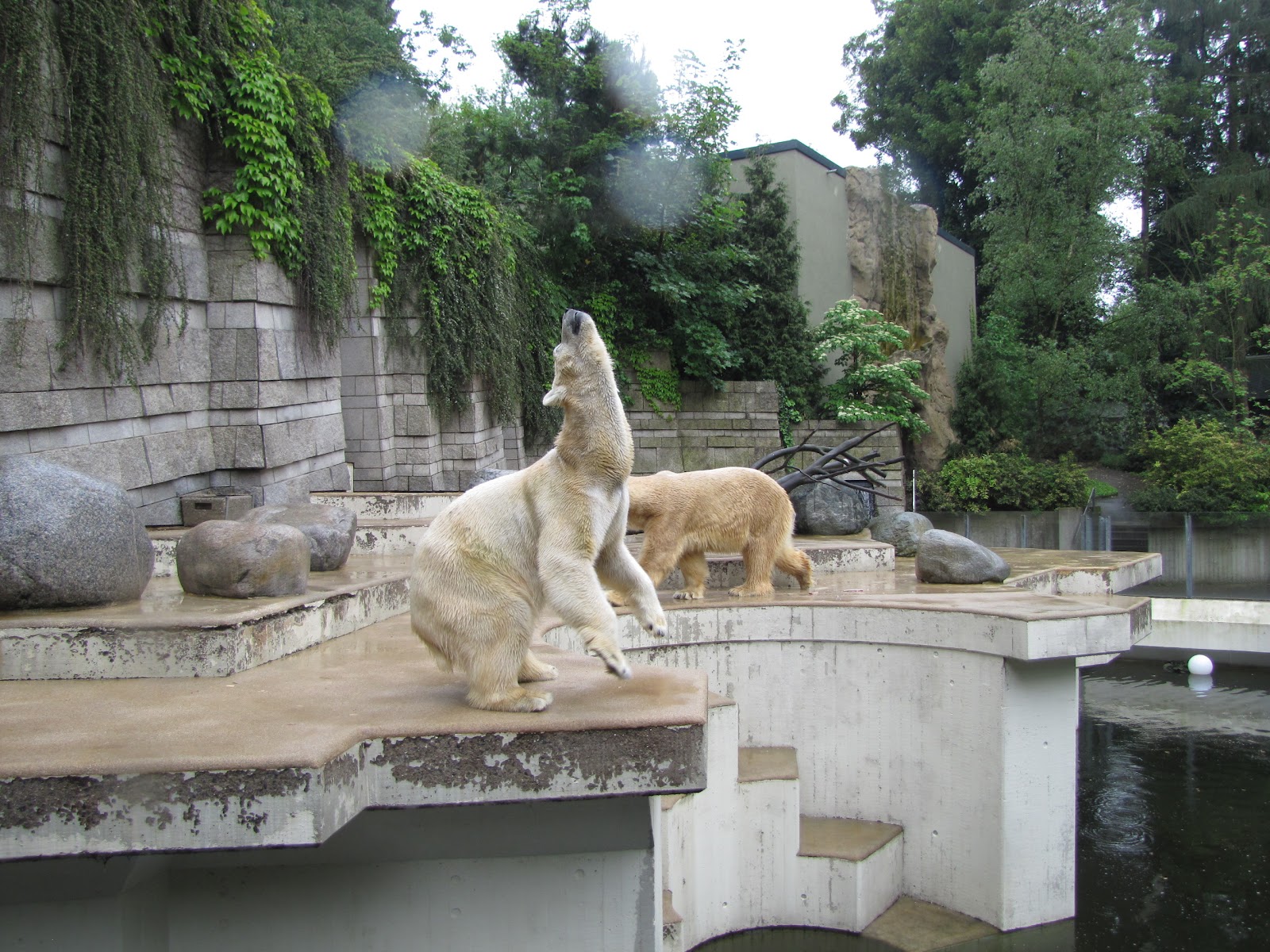
On the day I visited in May of 2011, Vilma and Lars were roaming around the main polar bear enclosure, which is not cub-friendly with all its steps and drop-offs, but provides an interesting habitat for the adult bears. The mother-cub area is smaller, and cub safe. The adult bears were given access to this area as well, but on the day I visited, they were in the main habitat. Vilma spent some time pacing, with her signature sudden twirling of her head as she turned, over and over. But she did spend some time swimming, and running up and down the stairs. Lars mostly concentrated on a snack.
Lars has a snack

Vilma looked thin last spring, which I think may have been the result of Lars' relentless amorous attentions during mating season. But she looked happy. Lots of smiles. Her coat had dirty spots, but after she went swimming, the dirt was gone.

Vilma's story

Vilma was born to Vienna and Churchill in Rostock Zoo in Germany in the spring of 2002. When she was two years old, she moved to Tiergarten Nuremburg where she lived happily with another lady bear Vera, and young handsome Felix.

Then came the unpleasantness after Vilma and Vera both gave birth in late 2007 to cubs. No one knows what really happened, and Vilma was a young, not quite 6 years old, a first-time mother. Some say that reporters and photographers disturbed the new mothers, making too much noise outside the den. Some suspect that Vilma's two cubs may have been sick or even died. There were no cameras installed in the den. All we know is she gave birth to two cubs, and seemed to be taking good care of them, but in early January of 2008, Vilma's cubs were just gone one day, and the assumption was that she ate them, something that happens when a cub dies, or is sick. Anyway, there was a public outcry against the zoo and against Vilma, who was just doing what her polar bear instincts dictated. None of what happened was in any way her fault. But she was vilified by the public, and according to newspaper accounts, Vilma was called horrible names by the visitors.

Also in early January, Vera started acting strangely with her surviving cub, taking her outside and dropping her. The zoo rapidly reversed its policy on non-interference, and decided to take the cub and hand-raise “Flocke,” who quickly became a worldwide media sensation and gave quite a boost to zoo attendance.

A few months after Vera and Vilma had their cubs, Felix moved to the Aalborg Zoo in Denmark in the spring of 2008, where he took up with resident ladies Malik and Vilma's older sister Victoria, with both of whom he eventually had cubs.

When celebrity cub Flocke was old enough to need a home of her own at Tiergarten Nuremburg, Vilma was moved back to Rostock, and at Rostock, the only male bear around was her father, the mean Churchill. So Vilma didn't have a chance to have more cubs. I had always hoped that young Vilma would find a home where she would have a chance at proving that she could be a good mother. At Rostock, Vilma shared a home with her mother Vienna, and just waited.

Lars

Lars, born in December of 1993, was Knut's father in the Berlin Zoo. He had moved to Zoo Wuppertal in October of 2009, where he was introduced to a lovely 20 year old lady name Jerka. They got along beautifully and playfully, and everyone had high hopes for the pairing. But tragedy was to come. In June of 2010, both Jerka and Lars became terribly ill with a sudden mysterious illness that damaged their kidneys. Sadly, Jerka did not recover, and Lars was on the brink of death, but finally did recover. And although Lars would not know it, his celebrity son Knut died at the Berlin Zoo suddenly in March of 2011.

In the fall of 2010, Vilma moved to Zoo Wuppertal, where Lars was living.


Vilma paced, and as she turned, she twirled her head


Vilma

Vilma


Vilma considers going swimming

Vilma wears a dirty patch on her fur

Vilma


 After an active Spring together, and a companionable summer, Vilma was shut up in the birthing den at the zoo in the late fall, where she gave birth to two cubs. This time there was a den cam, and the world was treated to a few photos of Vilma cuddling her little baby, named Anori, which means “The Wind.” One of the cubs had died at the age of one week, and Vilma buried that cub. But Anori was strong. This time Vilma is getting to raise her baby.

So for now, Vilma is a busy new mom, tending to her cub and enjoying having the visitors tell her what a wonderful mother she is. Vilma, you are a very good mother.


Sunday, March 4, 2012

Neil, Buzz and the Minot Bears

Buzz enjoys a snack from his puzzle feeder 


Neil works on his puzzle feeder as part of the zoo's enrichment - Buzz is in the background, having his own snack.


Buzz and Neil, 16 year old brothers at the Como Zoo in St. Paul, Minnesota, have spent most of the past year playing host to three flood refugees from the Roosevelt Park Zoo in Minot, North Dakota, Goldie the Grizzly Bear (a male), and Brown Bears Judy and Sandy (lady bears) are enjoying the run of the right-hand half the brand new polar bear habitat at the Como Zoo, until they can return home to Minot, hopefully in the next few months. A much improved new bear habitat is being built in Minot, but the perimeter fencing at the Roosevelt Park Zoo must be solid and safe before the brown bears can return.
Goldie the Grizzly Bear, and one of the Brown Bears

The Roosevelt Park Zoo was under 4 feet of water for several months last spring, due to heavy rains and snow melt. Since the waters receded in July, the zoo has been working to rebuild for the 2012 season. Minot, North Dakota, about 500 miles away from St. Paul, Minnesota.

The Como Zoo also offered a temporary home to some poison dart tree frogs, still at Como, and 13 endangered African penguins, who have since moved to a new penguin habitat at the nearby Minnesota Zoo.

Some of the affected Minot hoofed animals, such as llamas and bison, were taken in by local farmers in the Minot area. Other animals moved into a roomy old furniture warehouse that was quickly retrofitted as an indoor zoo, still in use. Still other animals were sent to zoos around the country. The Tanganyika (Tan-GAHN-yee-cuh) Wildlife Park is hosting three giraffes, two lions, two tigers and two Amur leopards from the Roosevelt Park Zoo.

Neil and Buzz were themselves houseguests for two years in the fabulous polar bear habitat at the Detroit Zoo, while their new home at Como was under construction. Polar Bear Odyssey at the Como Zoo opened June 3, 2010. The brothers enjoyed the run of the place for a year, and then Goldie, Sandy and Judy arrived in June of 2011.

Goldie the Grizzly Bear from Minot
The three Minot bears were quarantined for a month before they came out in public, to make sure they weren't bringing in any diseases or parasites for the other bears. For most of the past year, the central training area connecting the two bear yards was closed off, but Neil and Buzz could see their visitors from the bedrooms in the living area. A few weeks ago, the polar bears were allowed back into the training area, and Buzz spent a good deal of time when I was there, pawing at the locked door, curious about the new neighbors, or as he probably calls them, the invaders.

The brown bears are living in the right hand habitat, which has the deepest pool, good for fishing, but they mostly stay out of the water. That side has been the one preferred by Neil and Buzz, until it was taken over by the visitors. Zookeeper Cindy said that Neil and Buzz will be very happy to get their favorite area back. Since they have gotten used to the left hand area, it will be interesting to see which side they prefer now.
Even though it is winter, the brown bears aren't really hibernating. They have a good food supply, so they stay active through the winter.
One of the Brown Bears, Judy or Sandy, and Goldie the Grizzly


Cuddly Brown Bear - Judy or Sandy

Brown Bear
Goldie takes a drink


I visited the Como Zoo on February 25, two days before International Polar Bear Day, and Zoo keeper Julie Yarrington talked about her trip to Churchill, Manitoba Canada, under the auspices of Polar Bears International and the American Association of Zoo Keepers, for a week long leadership camp. She said that polar bears in the wild are very different from zoo bears in the way they act, and their attitude, and she learned a lot from her trip to the Hudson Bay area.


Polar Bears International worked with the Como Zoo in the design of Polar Bear Odyssey, which mimics the ecosystem of the Hudson Bay. The exhibit has many educational aspects, as well as daily zoo keeper talks. Here, Justin holds a ceramic bear showing the size (one pound) of a newborn polar bear.


Neil spent most of the afternoon in the dry moat, chasing around some big white barrels, but was finally lured out by the promise of some yummy food, stuffed in a puzzle box.
Neil - see the spots?
Neil has rubbed a couple of spots of fur off his behind.


Buzz wants to break down this door to get to the visiting bears.
Buzz 


Neil and Buzz - and some fun food

End of the day and Neil takes a nap in his bedroom