Showing posts with label Anori. Show all posts

Tuesday, September 14, 2021

Wuppertal's polar bear home was revolutionary in its day


 9 month old cub Anori, with Mom Vilma above,
in 2012.

 
Vilma swims in the pool, as little Anori plays
 on the steps of the Art Nouveau architecture
 
 of her home. 

I cannot think of a polar bear habitat still in use that is older or more stylish than the beautiful Art Nouveau / Art Deco creation of Zoo Wuppertal. It was designed to be a work of architectural art, and built in the early days of the 20th Century, just as the Victorian Age was ending. This multi-faceted exhibit, which has had improvements added over the years, incorporates many features that modern enclosures boast, such as smell ports with sea lions on the other side, underwater viewing window, various levels of diving platforms, and a large swimming area.


                                                    Luka and Anori, 2016

The climbing steps, designed to suggest random ice floes piled one on top of the other, keep a polar bear's back leg muscles strong. Newer polar bear habitats emphasize varied levels, just as this century old design exhibits.

This was one of the first zoo enclosures based upon Carl Hagenbeck's idea of open exhibits for zoo animals, without bars, to give the animals a more natural home. Hagenbeck came up with the idea of using giant wire forms covered with concrete to construct somewhat natural looking exhibits, some with mixed species separated by moats within the exhibit.


                                 Hagenbeck's Polar Panorama.

 The Wuppertal design is even more advanced than Hagenbeck's.  The polar bears are separated from the visitors without the moats that Hagenbeck used as barriers. The designer used granite blocks for the back walls of the habitat.


                                          Overlooking the pool

The Wuppertal enclosure must have been quite the sight in those early days, back when even the Schwebebahn was new. Visitors would have seen an imposing architectural wonder, gleaming white and resembling an alabaster  temple. Nowadays, the paint is peeling, but it still is impressive and the bears seem to love it. Lush vines drape over the stones, adding to the beauty. The vines turn scarlet every autumn. 

I imagine that when the Wuppertal polar bear home was first opened, it had railings instead of the current glass barriers overlooking the pool on both sides.


                                 Vilma and Lars in Wuppertal in 2011

Over a century ago when virtually every other zoo kept their polar bears in cages, or possibly in the newer but still primitive bear pits, Wuppertal built a first class home for polar bears that even now is impressive. It may not meet the very high standards of modern polar bear keeping because of its more limited space and lack of grass, but it certainly is grand. With the addition a few years ago of the mother-cub enclosure out the back with its coziness and soft surfaces, the polar bears get plenty of exercise running back and forth, in addition all the swimming.

The mother-cub room has a lower area which can serve as a shallow pool for a young cub, or be drained for more play area or a mulch pit.


                                                             Anori at 9 months


           9 month old Anori and the underwater viewing window, 2012.


Zoo Wuppertal was founded in 1879, with exhibits in buildings on beautifully landscaped grounds designed by garden expert Heinrich Siesmaye. It continues to be known for its lush vegetation, rolling hills and great variety of trees. The Green Zoo.


                                 Anori (top) and Luka in 2016

The polar bear and seal/sea lion installation, the "Northland Panorama," was the first outdoor exhibits to be built at Zoo Wuppertal, right after the turn of the century, maybe 1910 or before. I haven't been able to find the exact date, but it was very early in the last century. The first polar bear cubs were born in 1931.

One of Wuppertal's more famous residents was Boris, a polar bear with a distinctive craggy face unlike any other. I did not meet Boris, as he died in 2009, but I did visit his daughter Szenja of SeaWorld San Diego. Three cubs he fathered in Wuppertal were Troll (who went to Tierpark Berlin, and died in 2015), 28 year old Candy of Japan, and Szenja, who died in 2017.

                              Szenja in SeaWorld San Diego


Another famous resident of Wuppertal was Lars, father of the famous Knut. He came to Wuppertal in 2009, where he and Jerka, female polar bear, got along well. And then tragedy struck. In 2010, Jerka became deathly ill with a mystery illness, and then Lars as well. Jerka did not recover, and Lars was very sick for weeks, but slowly regained his health. It was later determined to be a form of herpes from Zebras, maybe carried by mice from the far away zebras to the polar bear enclosure.

When Lars was recovered, another female arrived from Rostock. It was Vilma, and in January of 2012, she gave birth to Anori. Lars went to Rostock then, because Vilma and Anori would need the room at Wuppertal. By that time, the new mother cub room had been constructed. Anori is the only cub to have used it.

Anori's birth created quite the stir. Long lines formed to get a glimpse of this little girl when she was old enough to be presented to an adoring public. The press was there too, and photographers just couldn't get enough photos.

In 2013, Vilma moved to Rostock where Lars was waiting for her. They later had another cub, Fiete, who now lives in Hungary. Lars fathered a set of twins, Qilak and Nuka, in Aalborg Denmark. Vilma and Lars are gone now.

Anori's cousin from the Netherlands, Luka, arrived to be playmate for the nearly three year old cub. 

 
                               Water games with Luka and Anori.


Anori and Luka spent seven years together in Wuppertal, and always seemed to be having a grand time. They had inventive toys and enrichment, and loved to run from the pool area through the house and out to the mother cub area, then back again. There were pool games and contests, a tug of war, playing tag around the raft, always something to do. Birthdays were celebrated with huge colorful cakes and even more new toys, with cheering and singing by crowds of fans on those wintry party days.


                                                   Anori and Luka (in back)

But recently zoo officials decided that the time had come to close down the old polar bear habitat, when suitable homes could be found for Luka and Anori. It didn't meet the standards set by the newer enclosures, and it requires a lot of water, which is expensive in the Wuppertal area. 

A year ago, Luka moved to Yorkshire Wildlife Park in the UK, where he has lots of grass to roll in, and three other young males as companions.

Now, Anori is getting ready for her big journey to France. The historic polar bear structure will not go to waste for the sea lions are preparing to move in. They have probably had their eye on the neighboring property for some time!


          There are many levels for play. Here are little Anori and Vilma


The California Sea Lions are just below the polar bears, and will  expand their area, when Anori leaves.


The mother-cub area was a new addition. 


School children get a good luck at the cub, Anori, in the mother cub area


                    Anori standing while Luka watches in the mother cub room


             Walking up from the zoo entrance, there are the polar bears.

After more than a century, this Wuppertal landmark will be closing down as a polar bear home when Anori leaves in the coming weeks.

A traveling box has been placed in her area, so Anori can get used to it. Her new home will be in Mulhouse, France, where she will live with her cousin Sesi and cub Kara. There are two beautiful spacious grassy enclosures there, one with a smaller splashing  pool, and the other has a larger pool with a huge viewing window. As in Wuppertal, the keepers there give the polar bears lots of toys and enrichment, so Anori will be happy.


Luka underwater in 2015

Even with the polar bears gone, the Green Zoo Wuppertal will continue to be a fine place to visit. Their elephant family seems to always have one or two new babies. The interior penguin exhibit up behind the polar bear habitat is new and exciting with a 15 meter long viewing tunnel to see the King and Gentoo penguins, while the African penguins live just across the road from the Sea Lions, and they are a lot of fun to watch. The lion habitat is the largest in Germany and well worth the climb up the mountain to get there.


                   Baby Gus the elephant and his family in Wuppertal in 2019


                                        African Penguins in Wuppertal


Thursday, December 3, 2020

Anori and Luka part ways


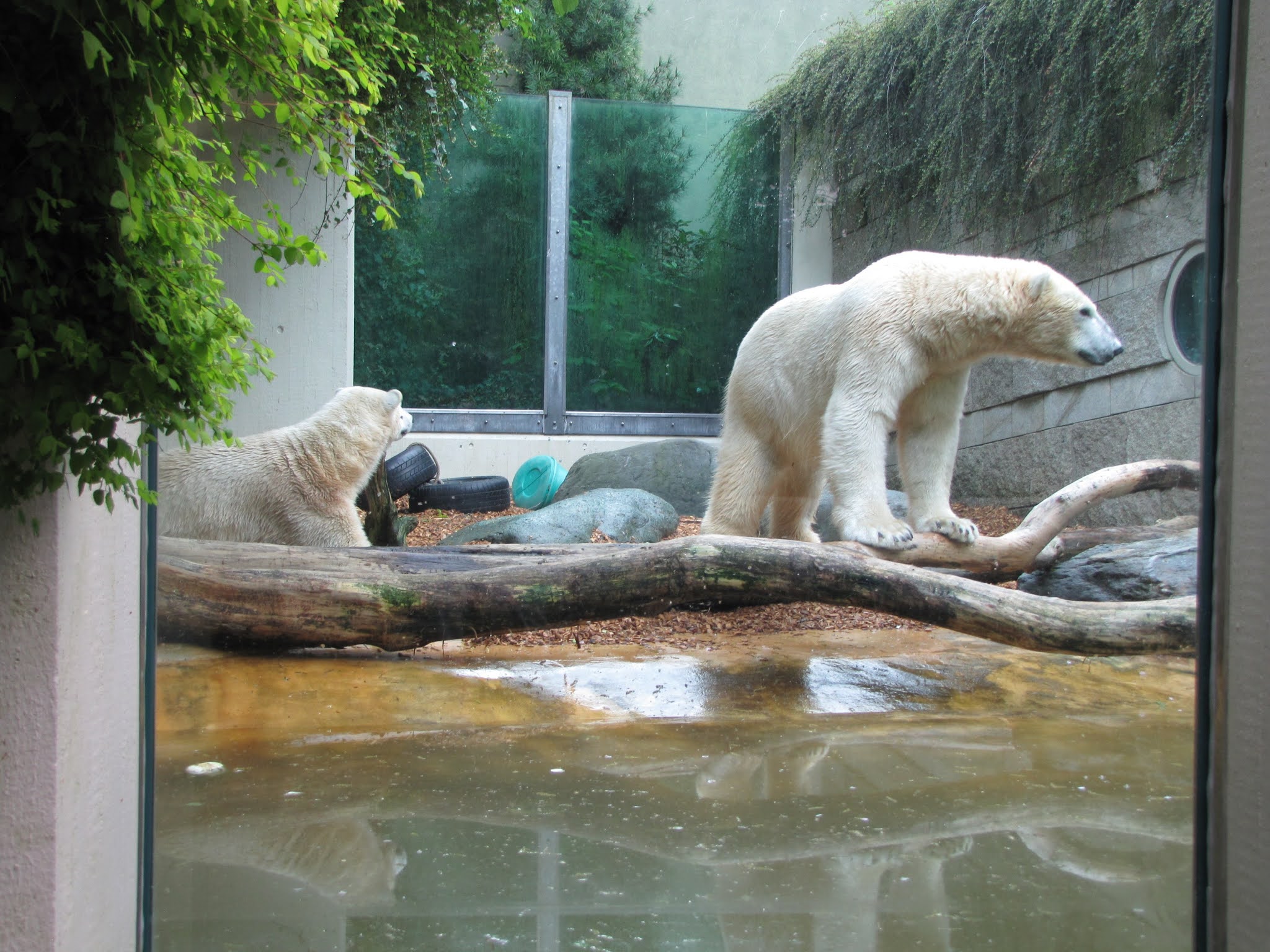
Luka and Anori in Wuppertal 

It has been a busy week for nine year old Luka. 

Tuesday was Luka's birthday at Zoo Wuppertal in Germany, where he has lived with Anori for seven years.

On Wednesday, he climbed into his transport box, which had been put into his area a couple of weeks ago so he could get used to it.

Welcome to Project Polar at YWP 

Today, Luka finds himself in Yorkshire Wildlife Park across the English Channel, able to see and sniff his new companions, 7 year old Nobby and 3 year old Wee Hamish, separated by some small space and some bars. 

After a few days, when he adjusts to his roomy and grassy new environment, Luka will be introduced to the other two male bears. Hamish is a new arrival too, just come from Highlands Wildlife Park in Scotland a month ago. Hamish and Nobby already seem to be fast friends.

The meadows at YWP may still smell faintly of Pixel and Nissan, two other male bears who recently left for France. Luka's father Victor lived at YWP for many years, before his recent death. 
 

Luka and Anori getting friendly 

Luka and Anori

Luka and Anori on the stairs steps in Wuppertal. 


Luka and his twin sister Lynn were born December 1, 2011 in Ouwehands Zoo in Rhenen in the Netherlands. Their parents were wildborn Huggies and Victor, son of Churchill and Vienna.


Luka in the water

Anori on the steps

Anori was born in Wuppertal very late in that same polar bear birthday season, on January 4, 2012. Her parents were Victor's sister Vilma, and Lars, father of the famous Knut.


Luka in the underwater viewing area at Wuppertal 


Anori in front, Luka in back, in the Mother Child area

When Anori and Luka were nearing the age of two, Anori's mother Vilma moved back to Rostock, where Lars then lived. Young Anori needed a playmate, so Luka came from Ouwehands. The two of them grew up together.


Anori and Luka in the main enclosure, heading toward the diving platform


Ready to dive


Luka in the Mother Child area 

So for the past seven years, Anori and Luka have been playing, splashing, running and swimming together 


Luka grabs the crazy egg


Anori and Luka in the mother child area 


Luka on the platform, and there is a viewing area behind him


Luka and Anori with their toys


The polar bear enclosure at Wuppertal was built about a century ago, and at the time it was very forward thinking. A hundred years ago, most zoos kept polar bears in cages. Wuppertal was one of the first to embrace the revolutionary idea of  Hagenbeck's habitats without bars, where the animals can move about freely and naturally. The stylized enclosure was built of slabs of silvery white granite, featuring a large pool, stairs and diving platform. 


Luka on the bottom step


Luka and Anori in the pool 

While Wuppertal's ancient enclosure cannot compare to the new state of the art facilities of some of the other zoos, I have rarely seen happier bears than at Wuppertal. Innovative toys and puzzles give them lots to do and think about, and the keepers are always looking for new ideas for activities and enrichment. 


Luka and Anori always had lots of different toys, and they get creative

About ten years ago a cozy mother child enclosure was built onto the back of the living quarters, a sheltered area of soft surfaces and a shallow pool area in front of the viewing window. Anori is the only cub to have been raised there. Anori and Luka would swim in the big pool area and then run through the building and out the back to sleep or play or have a snack in the little garden, then back and forth again. All day long. 


Luka with his ring

Of course Anori and Luka have had each other too, and they became compatible friends, very good at sharing.


Luka

It is customary for keepers to go along for the trip and stay until the bear has adjusted to new people and environment. 


Luka and Anori, follow the leader

Facebook photos today show that Luka has arrived at Yorkshire Wildlife Park and already explored one of the grassy areas on his own. 

Luka says goodbye to Wuppertal 

He will find a very different kind of home at YWP, with four large bear enclosures with natural ponds, rolling grassy meadows and stone shelters. It is all very spacious and natural. There are even ducks and other birds to chase.

Anori with her toys

And where is Anori going? I thought maybe Rotterdam, which has two large enclosures, one for Olinka and one for Wolodja. There is probably room for one more. Karlsruhe has had three bears before. Maybe she could go there? We will just have to wait and see. Her birthday is coming up in a month. Will she celebrate again in Wuppertal, or be in her new home by then?

Monday, September 18, 2017

Farewell to Magnificent Lars

Handsome Lars

Lars in Aalborg

Taking care of zoo animals sometimes means letting them go, sadly. Today the world lost Lars, a beloved and legendary polar bear, to liver cancer.


Aalborg Zoo staff had detected something was wrong in the liver levels of blood taken during a dental procedure for Lars several weeks ago. Medical experts gave him a closer examination with ultrasound and found a large mass in his liver. It was terminal cancer. The best thing would be to end his pain.

Lars
In his almost 24 years, Lars has lived in a number of zoos, and many people have come to love him. He was well known as the father of the famous Knut, and also Anori and Fiete, and now the twins at Aalborg.

Lars in Aalborg
Lars was born December 12, 1993 in Munich, and moved to Bremerhaven when he was two years old. He has moved around a bit, living in Munster and Neumunster. He moved in 1999 to Berlin Zoo, where he lived for ten years with three lady bears: Nancy, Katjuscha and Tosca, and where he fathered Knut with Tosca in 2006. When mother Tosca rejected Knut, he was raised by hand by his keepers, and became world famous.

Lars loved his sticks and branches
In 2009 Lars moved to Wuppertal where there was a very nice girl bear named Jerka. In June of 2010, both Jerka and Lars became deathly ill with a mysterious illness that damaged their kidneys and cause serious brain swelling. 20 year old Jerka did not survive. It was a form of zebra virus causing encephalitis. Although Lars survived, it took a long time for him to recover.

Jerka and Lars in Wuppertal
In the fall of 2010, Vilma moved to Wuppertal, and the next year, Vilma gave birth to cub Anori. Lars moved to Rostock, where he lived with Vienna, Vilma's mother.

Lars and Vilma's mother Vienna in Rostock
Lars stayed in Rostock for three years, and Vilma joined him. Vilma gave birth to son Fiete in December of 2014.


Lars (closer) looks over at Malik

Once again, Lars moved to make room for the cub, this time going to Aalborg Denmark.  Vilma also came to Aalborg, but died shortly after her arrival of a somach infection. 


With Malik, Lars fathered cubs Nuka and Qilak, born just last winter.
Lars sniffs at a horse's head, given as enrichment.
 After a sniff or two, he was not very interested.
He was well loved by his keepers in Aalborg, who catered to his personality, always trying something new to interest him. When they heard that he enjoyed rolling in mulch, they immediately made a lovely soft mulch bed for him.


Lars in Rostock

Lars was a gentle bear, not as interested in toys and playing as some bears, but always watching, observing in his later years. He loved his melons and grapes and prunes and chewing on branches and leaves.


Lars in Aalborg, with his yummy leaves

Liver cancer has claimed a great many polar bears in zoos. Bears in the wild have a life expectancy of 18 to 20 years, and have perished before these diseases of old age, but zoo bears get good food and care and so live longer, and thus sometimes get liver cancer.


Lars in Aalborg

And so we have lost a great and legendary bear. He will be missed. Farewell, old friend.


Lars in profile