Saturday, July 3, 2021

Kulu is one big baby


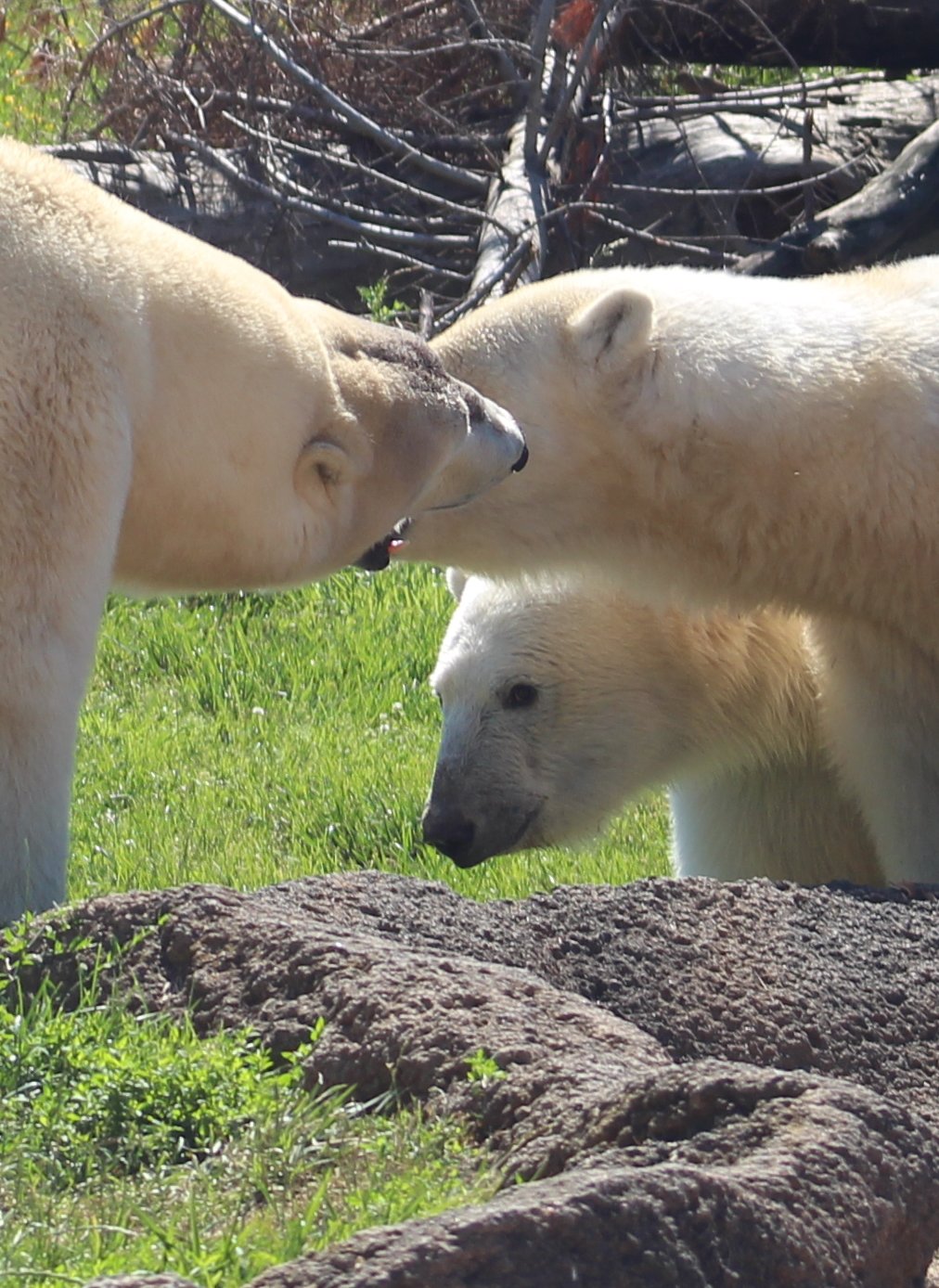
Aunt Anana on the left greets her twin sister Aurora,
 while Kulu peeks between
.


Visitors to the Columbus Zoo are amazed by the size of 19 month old polar bear cub Kulu. Compared to his mom and his aunt, who live with him, it isn't easy to tell them apart by size alone. You can tell it is Kulu by his cubbish ways, his never ending play.  Aurora can be told from the others by the dark paint on her paw, and by the "milk bar" since baby Kulu, heavier than his mom, is still nursing. 

Kulu's father Lee has moved to the Louisville Zoo.

Young Kulu leads his mom Aurora

Kulu, the only zoo polar bear cub in the US born in 2019, is just over a year and a half old, and is heavier than his mother Aurora and her twin Sister Anana. All three share the glorious enclosure at the Columbus Zoo. I have gotten several weight numbers on him, but all put him at about 600 pounds, very heavy for such a young bear. Aunt Anana weighs just a few pounds less, and mother Aurora, still nursing, is well under the weight of either. 


Sometimes Kulu likes to play close to his mom.

Kulu is pretty independent, so his mother can nap and watch him from a distance while he plays. He runs over to touch base with her every once in awhile.

Kulu top, Anana below

But now Kulu has his playful Aunt Anana to spend time with, and these two love to play. Anana knows how to deal with a cub, as she is mother to Amelia Gray, now almost five years old and living in Maryland with Aurora's daughter Neva of the same age. Aurora is also mother to Nora, almost six years old and living in the Oregon Zoo, and Neva's twin Nuniq, living in Kansas City. 

Mother Aurora and Kulu on shore,
while Anana stations herself in the prime spot for
 the Keeper Talk/ Snack Time.

When it was feeding time, and a keeper climbed up to the roof to throw down some goodies, Mother Aurora held back, staying on the shore, while Anana stationed herself right under the keeper, waiting for the best bits.

Mother Aurora and Kulu wait on shore for the coming snacks.

Soon Kulu jumped in to get what he could, but Aurora stayed on shore. Anana seems to be in charge of the snacks. The keepers always throw treats to Aurora on shore, since she refuses to go into the water. They got some fish, sweet potatoes and lettuce.

Kulu asks Mom to jump in.  Mom stays put.

Kulu knows to get the best snacks,
 he should swim up to the viewing window.  

Aurora and Anana's late grandmother Arki was particularly fond of lettuce.

Enough lettuce for all!

A little water fight between Aunt Anana and Kulu

Kiss and make up. Kulu is on the right. The reflections at the viewing window make photography a challenge sometimes.

Aurora still on shore. Kulu and Anana ask her to come in to play.
But no
.

Lettuce or toy? Kulu wants both.


Anana and Kulu at the window


Kulu goes off to play by himself. He likes this ball. 

Kulu stalks the ball, ready to pounce.

And he pounces. It is a natural behavior necessary
for hunting seals in the wild


While her sister Anana takes a nap, and her son Kulu plays on his own, Mother Aurora enjoys some peace and quiet in the shade. Note the dark spot on her paw, so keepers can tell the sisters apart.

Saturday, June 12, 2021

End of an Era at Marineland


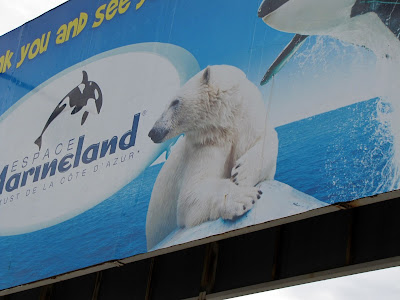
The sign in the parking lot of Marineland in 2017

This week it was announced by Marineland in Antibes, France,  that Flocke and her triplets had already moved to Yorkshire Wildlife Park, and the polar bear habitat on the French Riviera would become home to penguins. The French aqua park would no longer have polar bears. Marineland had been closed for a time because of the Coronavirus pandemic, and was announcing that it would reopen to the public on June 11.

Marineland was home to polar bears for 11 years, from April of 2010 to June of 2021.


In the old days, at Marineland, Flocke rests on top of the stone arch,
 while Raspi waits for her to come down. Raspi always wanted to be with Flocke. Flocke sometimes wanted a break.

Marineland had been closed in the spring of 2020, but did reopen for a time in the summer and fall, then closed again. 

Flocke and Raspi together in 2018, after daughter Hope left for Sweden

The rare birth of polar bear triplets made it even sadder that the park was closed for so many months, but some European visitors were lucky enough to see the cubs. I, being in Ohio, missed that experience, but my friend Ralph from Oxford, England, went for a week in August of 2020, when the cubs were still rather small.

My friend Ralph traveled to France to visit Flocke and her cubs,
and gave me permission to use this photo of the little family.
 Raspi had already moved to YWP

The triplets' father, Raspi, had moved to Yorkshire Wildlife Park shortly after the cubs were born, so Flocke could raise the kids in peace and quiet. For ten months, Raspi lived in YWP, separated and at a distance from the other four bachelor polar bears, from the end of January to mid November 2020, at which time he moved to Tallinn, Estonia as a companion to female bear Friida.

At Marineland in 2018, Flocke swims and Raspi waits for her.

Flocke was born to Vera and Felix in Tierpark Nuremburg in 2007, where she was raised by four keepers. Rasputin, or Raspi, born in Moscow to Murma and Untai, came to Nuremburg when he was 11 months old, about the same age as Flocke, as a companion for Flocke and they grew up together. In 2010, they moved to Marineland, the first and only polar bears to live in this aquatic theme park in Antibes on the French Riviera. 

Flocke with Hope, who was born in 2014 in Marineland

There in Marineland, Flocke and Raspi enjoyed three spacious enclosures. The top two enclosures feature large pools, rocky areas and grass, while the lower enclosure was built for mother and cubs, with a shallow pool, babbling brook, and a grassy meadow, as well as a snow cave. There is also a snow cave in one of the top areas. The bears could enjoy cooling breezes from the Mediterranean Sea, just  down the hill, or if they prefer, the air conditioning inside.  The keepers have taken wonderful care of the bears. 

Raspi and Flocke's first cub Hope was born in 2014.

Little Hope in Spring of 2015

Hope and Flocke in the ice grotto.

It is a shame that this state of the art facility for polar bears is now empty, but it will still be of use, for the Marineland penguins. 

Flocke and her tree at Marineland

So why did Marineland decide to send the polar bears away? Animal rights organizations have been protesting the park, marching around near the entrance with signs, mostly about the Orcas, but others have criticized them for keeping polar bears in a Mediterranean climate, even though the temperature there right on the edge of the sea is not much different than in other European cities that keep polar bears. A British tabloid did a slanted story about the polar bears at Marineland, full of inaccuracies and intended to rile people up. The people who own the park decided to pick their battles, I suppose.

Raspi, behind the gate, could come down and visit his
daughter Hope in the lower enclosure.


Hope is entranced with a visitor on stilts.
The Marineland bears loved to see who was coming to visit.


After Raspi left YWP for Tallinn, the remote enclosure where he lived at YWP, with rolling grassy meadow, climbing structure, foliage and a lovely pond in which to swim, was empty. It seemed to make sense for Flocke, along with her 18 month old cubs, to make the move to the UK. 

The entrance to Project Polar at YWP
where the bachelor group of four young males lives.
Flocke's home is across the park.

So now there are eight polar bears at YWP. Flocke and her cubs are some distance from Project Polar, where the young boy bears (Nobby, Hamish, Sisu and Luka) live, rotating through three spacious enclosures, each with a big pond. Polar bears have very sensitive noses, so the boys might smell a female, but it would be faint, not dissimilar to Highland Wildlife Park in Scotland, where Victoria lives alone, on the other side of the park from Arktos and Walker except during breeding season.

There will be a settling in period, where Flocke's family will have time to adjust to their new home without visitors watching them.

I visited Marineland many times, always staying for four or five days at a time, at the Bastide de la Brague across the road from Marineland.  The bears had much to keep them busy, with toys and other enrichment. Raspi always liked to swim his laps, unless he could be with his Flocke.

Raspi swimming his laps at Marineland

Flocke and Hope, swimming and playing

Flocke, who had been raised by humans, amazed everyone with her great mothering skills with daughter Hope, and is doing a great job of raising triplets.

So, after the initial period without the public, the folks at YWP will have fun getting to know Flocke and her cubs, the boys Yuma and Indiana, and daughter Tala, also called Rasputina by some because she is so like her father.


Flocke was all dirty, and Raspi didn't care. He always thought she was beautiful.

I will miss my beautiful days on the French Riviera, and all the lovely people I have met there. It was an idyllic place for polar bears to live and play. I am sad that those magical days are over. 
Saturday, April 24, 2021

Update: Anana's death was from natural causes

Anana in Brookfield Zoo, Chicago


The news of the tragic death of Anana at the Detroit Zoo on February 8, just a little over two months ago was all the more heartbreaking to think that another much loved bear, Nuka, had killed her during attempted breeding. Anana was adored by zoo visitors from the Brookfield Zoo, Buffalo Zoo, Cincinnati Zoo, and her final home at the Detroit Zoo.

It is a relief to know the truth now, with news of the results of the autopsy.

An independent commission of experts has studied what led to Anana's death, and their results were shared this week with Detroit Zoo members through an email. 


Anana in Cincinnati


The following was sent out in an email to the Detroit Zoo members this week from the Detroit Zoological Society.

DZS recently completed an in-depth review into Anana’s death and, working with veterinary pathologists at Michigan State University, discovered that she died from advanced heart disease. She was not killed by male polar bear Nuka, as was originally believed. The DZS’s Animal Health External Review Panel, a group of experts in veterinary and human health, endorsed this conclusion.
Analysis of Anana’s heart tissues showed that she experienced acute heart failure or a fatal arrhythmia before or during breeding attempts. It was impossible to know that she had a cardiac condition called multifocal myocardial fibrosis, as she showed no clinical signs and a 2020 medical examination noted no abnormalities in her heart function. Wounds on Anana likely resulted from Nuka holding her with his teeth, as is typical during polar bear breeding. He was also observed moving her around the habitat after she became unresponsive, possibly because he was confused by her behavior.
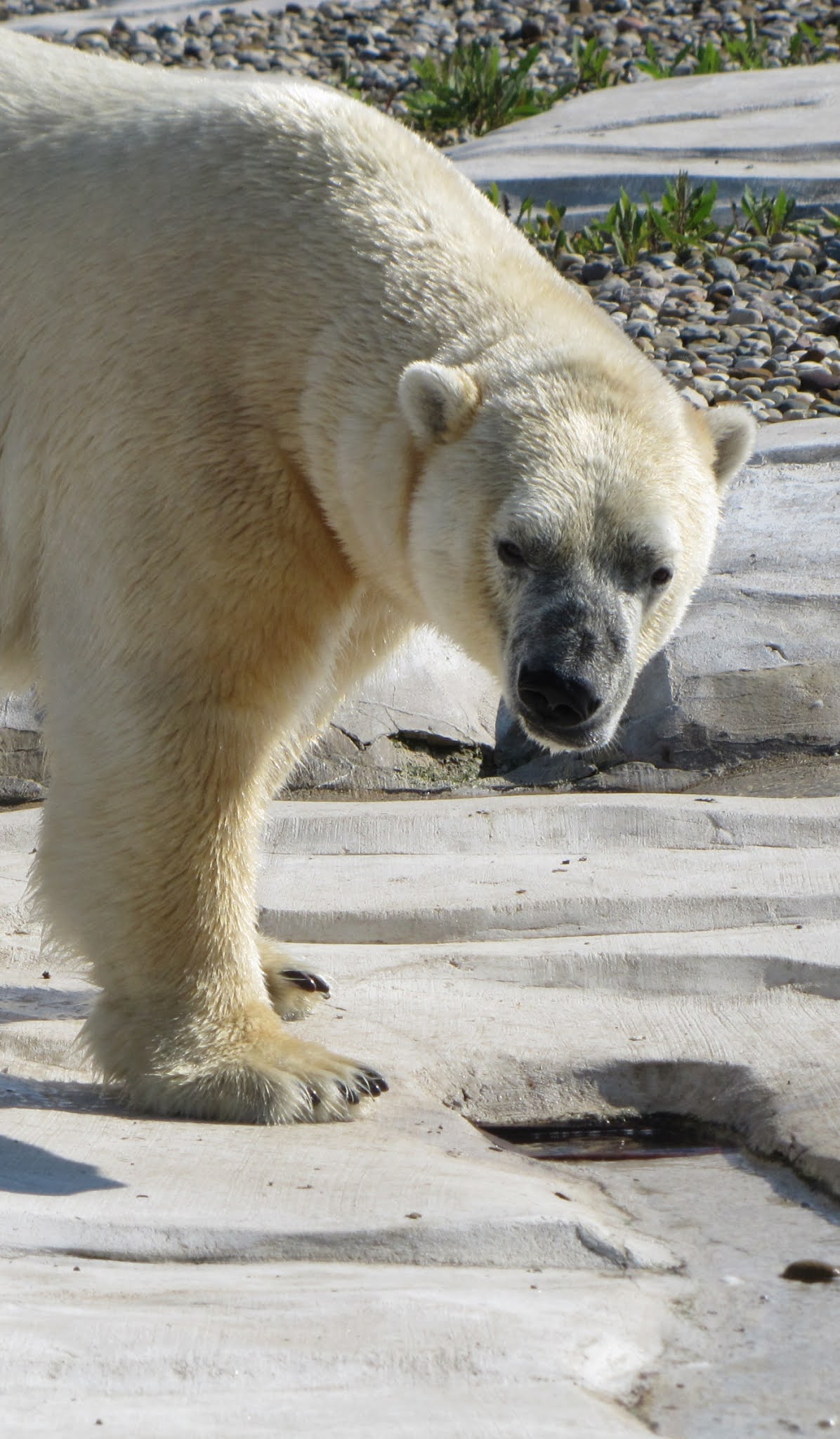
While DZS continues to mourn Anana’s loss, the polar bear staff is focused on caring for Nuka, as well as female Suka and her 6-month-old cubs. Laerke (the cub being reared by staff) is living in the polar bears’ building, but is separated from the other bears while she gets to know them from a distance. Suka and Astra (the cub she is raising in the maternity den) will soon be exploring the Arctic Ring of Life’s Tundra habitat.

Anana


From the start, Nuka was presumed guilty, but now has been found innocent of causing Anana's death. It sounds like the wounds were inflicted upon her face and neck by Nuka's efforts to wake Anana up after her heart failure.

Nuka is the father of the Suka's twins and we will be able to see these cubs, one raised by their mother Suka and the other by keepers, in the coming weeks at the Detroit Zoo.  A shadow over the happy events surrounding the new cubs has been lifted with the news that Anana's death was from natural causes. 

Anana was born at Hogle Zoo in Salt Lake City on December 12, 2000. The petite lady bear, weighing in at only 450 pounds, had one daughter, 8 year old Luna, now living in the Buffalo Zoo with Suka's brother Sakari. Anana died of heart failure in Detroit on February 8, 2021.


Nuka, father of the cubs

Suka, mother of twins, in Detroit


Saturday, March 27, 2021

A final farewell to Little One


One of my favorite photos of Little One.
He was stealing Berit's heart during Valentine Enrichment back in 2015.


Little One

Such sad news today, from the Cincinnati Zoo. Little One was euthanized this morning, suffering from renal failure. At age 31, he was the oldest male polar bear in the country. He was active up until his final few days, when he seemed to lose interest in his activities and his food.

He was born in Cleveland December 13, 1989, and came to the Cincinnati Zoo in 2007.

His mother was Snowball and his father was Nauyet. Little One's brother Blizzard, born in 1984, was the mate of Snow Lily, and the father of the late Tundra. He died in 2006.

His only living relative is a sister, 29 year old Satuki in Asahiyama Zoo in Hokkaido Japan.

Little One has enjoyed great companionship over the years, first with Rizzo and Berit, and then with the lovely little Anana.

He was a popular guy at the zoo, with a great many fans who will miss him terribly.

Since Cincinnati is my local zoo, I have visited Little One many times over the years, and have put together a little photo gallery in remembrance of the good times.


Little One enjoyed his enrichment snacks, here a little watermelon.


Berit, now in Wisconsin, and Little One 

Anana, now also gone just in February, and Little One


Little One and Anana in 2018

Little One was very fluffy, and had lots of fur on his feet

Little One on his 31st birthday, last December 13 

In the days when we had three polar bears in the Cincinnati Zoo.
Little One, Rizzo and Berit

Little One and Rizzo in 2012

Rizzo and Little One in 2012

Little One liked his toys at times, 
 especially if someone else wanted to play with them.

Little One peeking through the gate between enclosures

The last time I saw Little One, just last month. It was February 23.
He was out and about and seemed fine.


Rest in Peace, Little One. You were well loved. Now there are no polar bears at the Cincinnati Zoo.