Showing posts with label Marineland. Show all posts

Wednesday, September 10, 2025

The loss of Hope

Young Hope at Marineland
We just received the terrible news of Hope's passing during a dental procedure at Jimmy's Farm and Wildlife Park. The daughter of Flocke and Raspi, she would have been 11 years old in November.

Flocke and Baby Hope in 2015


Flocke and Hope in 2015


Hope at 5 months in Marineland

Hope seemed to have lead a charmed life. She was a beloved new arrival at Marineland on the French Riviera when the famous Flocke gave birth back in 2014. Because Flocke was raised by her keepers, some doubted that she would have the mothering instinct, but Flocke turned out to be an exemplary mother.


Hope and Flocke in 2017


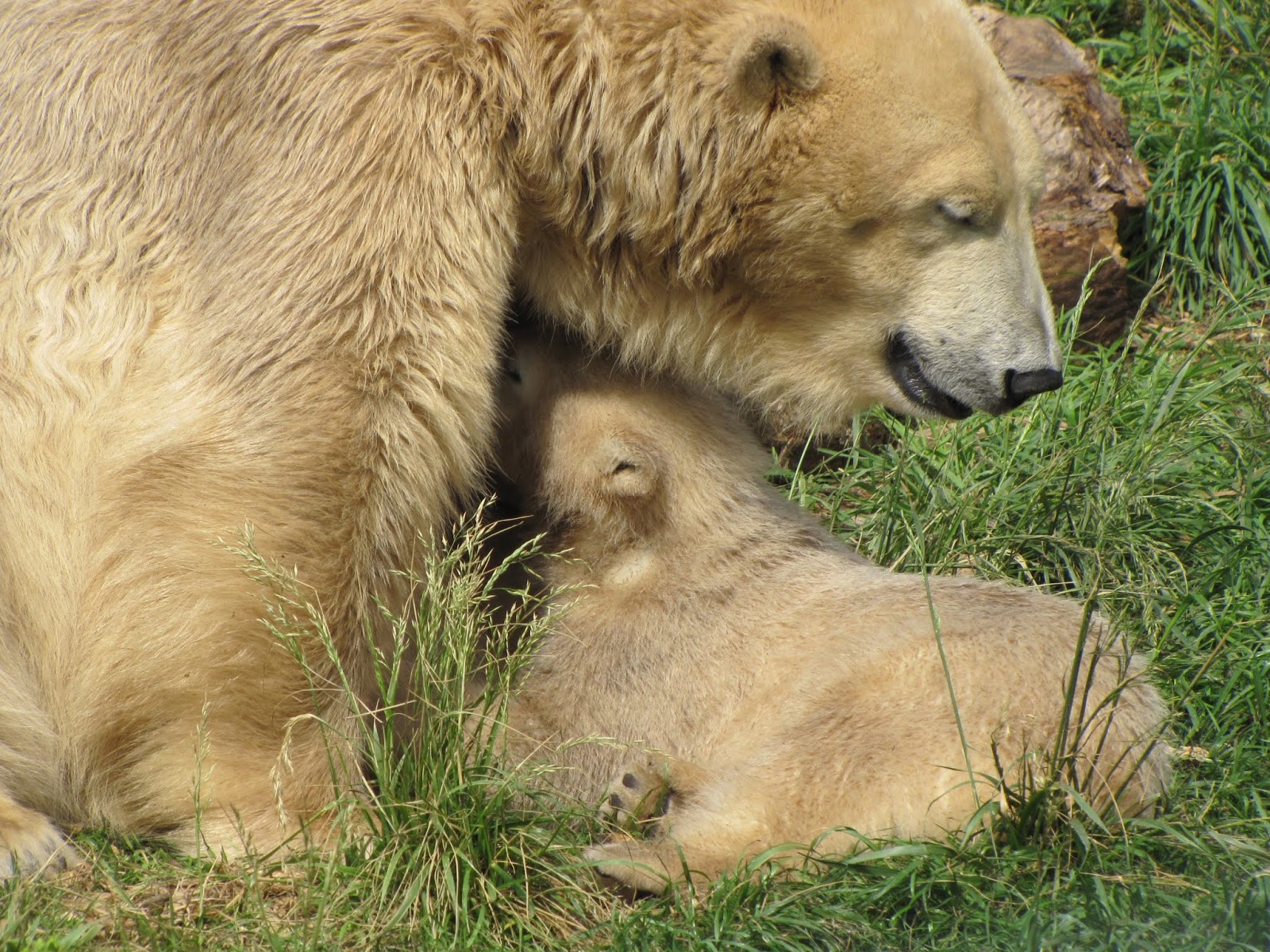
Hope  grew up adored by so many, and lived in a magical place. She even had a snow grotto, which she loved to roll around in with her mom Flocke. 


Flocke and Hope in the ice grotto


Dad Raspi was curious about his daughter and she was also interested in what Raspi was doing. It was a lovely family and there was always something fun going on.


Hope visits with Daddy Raspi


Flocke and Hope in 2017

Hope and Flocke in 2016

In 2018 Hope was three years old, and moved to Orsa Bear Park in Sweden, where she lived in a snowy wilderness with Eva and Wilbär. There she gave birth to twin boys in 2021, Nannok and Noori. 

Hope's father Raspi moved to Yorkshire Wildlife Park, then to Tallinn Estonia, and is now in Aalborg Denmark. After Raspi moved from YWP, Flocke and her triplets moved from Marineland to Doncaster to the same enclosure Raspi had occupied, far from the bachelor group. Sadly, Marineland eventually closed, but the bears had already moved.

Drama for Hope and the other polar bears in Orsa ensued when the Park was announced to be closing, and after some scrambling to find the bears a new home, Hope and her boys were sent to Peak Wildlife Park in the UK. Ewa moved to Jimmy's, and Wilbär moved to Ouwehands.

The boys Nannok and Noori stayed behind at Peak Wildlife Park when Hope moved to Jimmy's Farm and Wildlife Park last year, where Hope was reunited with her mother Flocke, and also her old friend Ewa. Hope met her younger sister Tala there too. The other two of Flocke's triplets, the boys Indie and Yuma, live in YWP in Doncaster.

Hope was a lovely bear. It was nice that she could be reunited with her mother and meet her sister. The family partly back together again. We will all miss sweet Hope.


Hope in Marineland


Saturday, June 12, 2021

End of an Era at Marineland


The sign in the parking lot of Marineland in 2017

This week it was announced by Marineland in Antibes, France,  that Flocke and her triplets had already moved to Yorkshire Wildlife Park, and the polar bear habitat on the French Riviera would become home to penguins. The French aqua park would no longer have polar bears. Marineland had been closed for a time because of the Coronavirus pandemic, and was announcing that it would reopen to the public on June 11.

Marineland was home to polar bears for 11 years, from April of 2010 to June of 2021.


In the old days, at Marineland, Flocke rests on top of the stone arch,
 while Raspi waits for her to come down. Raspi always wanted to be with Flocke. Flocke sometimes wanted a break.

Marineland had been closed in the spring of 2020, but did reopen for a time in the summer and fall, then closed again. 

Flocke and Raspi together in 2018, after daughter Hope left for Sweden

The rare birth of polar bear triplets made it even sadder that the park was closed for so many months, but some European visitors were lucky enough to see the cubs. I, being in Ohio, missed that experience, but my friend Ralph from Oxford, England, went for a week in August of 2020, when the cubs were still rather small.

My friend Ralph traveled to France to visit Flocke and her cubs,
and gave me permission to use this photo of the little family.
 Raspi had already moved to YWP

The triplets' father, Raspi, had moved to Yorkshire Wildlife Park shortly after the cubs were born, so Flocke could raise the kids in peace and quiet. For ten months, Raspi lived in YWP, separated and at a distance from the other four bachelor polar bears, from the end of January to mid November 2020, at which time he moved to Tallinn, Estonia as a companion to female bear Friida.

At Marineland in 2018, Flocke swims and Raspi waits for her.

Flocke was born to Vera and Felix in Tierpark Nuremburg in 2007, where she was raised by four keepers. Rasputin, or Raspi, born in Moscow to Murma and Untai, came to Nuremburg when he was 11 months old, about the same age as Flocke, as a companion for Flocke and they grew up together. In 2010, they moved to Marineland, the first and only polar bears to live in this aquatic theme park in Antibes on the French Riviera. 

Flocke with Hope, who was born in 2014 in Marineland

There in Marineland, Flocke and Raspi enjoyed three spacious enclosures. The top two enclosures feature large pools, rocky areas and grass, while the lower enclosure was built for mother and cubs, with a shallow pool, babbling brook, and a grassy meadow, as well as a snow cave. There is also a snow cave in one of the top areas. The bears could enjoy cooling breezes from the Mediterranean Sea, just  down the hill, or if they prefer, the air conditioning inside.  The keepers have taken wonderful care of the bears. 

Raspi and Flocke's first cub Hope was born in 2014.

Little Hope in Spring of 2015

Hope and Flocke in the ice grotto.

It is a shame that this state of the art facility for polar bears is now empty, but it will still be of use, for the Marineland penguins. 

Flocke and her tree at Marineland

So why did Marineland decide to send the polar bears away? Animal rights organizations have been protesting the park, marching around near the entrance with signs, mostly about the Orcas, but others have criticized them for keeping polar bears in a Mediterranean climate, even though the temperature there right on the edge of the sea is not much different than in other European cities that keep polar bears. A British tabloid did a slanted story about the polar bears at Marineland, full of inaccuracies and intended to rile people up. The people who own the park decided to pick their battles, I suppose.

Raspi, behind the gate, could come down and visit his
daughter Hope in the lower enclosure.


Hope is entranced with a visitor on stilts.
The Marineland bears loved to see who was coming to visit.


After Raspi left YWP for Tallinn, the remote enclosure where he lived at YWP, with rolling grassy meadow, climbing structure, foliage and a lovely pond in which to swim, was empty. It seemed to make sense for Flocke, along with her 18 month old cubs, to make the move to the UK. 

The entrance to Project Polar at YWP
where the bachelor group of four young males lives.
Flocke's home is across the park.

So now there are eight polar bears at YWP. Flocke and her cubs are some distance from Project Polar, where the young boy bears (Nobby, Hamish, Sisu and Luka) live, rotating through three spacious enclosures, each with a big pond. Polar bears have very sensitive noses, so the boys might smell a female, but it would be faint, not dissimilar to Highland Wildlife Park in Scotland, where Victoria lives alone, on the other side of the park from Arktos and Walker except during breeding season.

There will be a settling in period, where Flocke's family will have time to adjust to their new home without visitors watching them.

I visited Marineland many times, always staying for four or five days at a time, at the Bastide de la Brague across the road from Marineland.  The bears had much to keep them busy, with toys and other enrichment. Raspi always liked to swim his laps, unless he could be with his Flocke.

Raspi swimming his laps at Marineland

Flocke and Hope, swimming and playing

Flocke, who had been raised by humans, amazed everyone with her great mothering skills with daughter Hope, and is doing a great job of raising triplets.

So, after the initial period without the public, the folks at YWP will have fun getting to know Flocke and her cubs, the boys Yuma and Indiana, and daughter Tala, also called Rasputina by some because she is so like her father.


Flocke was all dirty, and Raspi didn't care. He always thought she was beautiful.

I will miss my beautiful days on the French Riviera, and all the lovely people I have met there. It was an idyllic place for polar bears to live and play. I am sad that those magical days are over. 

Sunday, May 10, 2020

Happy Mother's Day to Flocke


Flocke and her first cub Hope, who was born November 26, 2014.


It made worldwide news. Flocke had given birth to triplets, and four months later, they are still doing great! 


Flocke and her newborn cubs, photo courtesy of Marineland

All in all, the end of 2019  was an amazing polar bear birthing season, with a dozen cubs born in Europe, and several in Russia. Even the U.S.A had a cub (in Columbus again, of course). The remarkable story, however, was Flocke and Raspi's little family. Everyone would want to come to the French Riviera to meet them.

Cruel fate, in the shape of a worldwide pandemic, has intervened, and Marineland is closed through at least the end of June. I was to have visited during the first week of May, taking lots of photos of this little family, followed by another trip to see the rest of the cubs. Instead, I must be satisfied to see photos and videos posted by Marineland, and hope for a visit maybe next spring?

One European cub did make her public debut before the lockdown. Fans could visit little Finja in Tiergarten Schoenbrunn in Vienna in late February.

Just recently a few of the other cubs could be met, although there are great restrictions in those zoos. Fans can visit Milana and Sprinter's daughter in Hannover, and the twins Anna and Elsa in Zoo am Meer in Bremerhaven are now receiving visitors along with their parents Valeska and Lloyd. 

Flocke and her babies, photo by Marineland

But Flocke and her triplets remain isolated from visitors, except for those who work in the park and for a recent photo op for the press, a very limited event.

Photo by Valery HACHE/AFP


Triplets who survive are quite rare in zoo polar bears, although not all that rare in Flocke's family.

A triplet birth at the Louisville Zoo in late 1992 gave us Aquila, Aurora and Arcturus, but all three are gone now.


The Louisville Triplets, Aquila, Aurora and Arcturus.
Photo courtesy of the Louisville Zoo


Skeena with her triplets in 1993 in the Louisville Zoo.
Photo courtesy of the Louisville Zoo
Flocke's great grandmother Uslada's gave birth to all male triplets in St. Petersburg in 2002, with Bering, Malygin in China and Sedov (Commodore) in a Russian safari park now. 

Victor and Huggies had triplets (Ewa, Henk and Jelle) in Ouwehands in 2005, named for their keepers. Ewa is in Sweden with Flocke's daughter Hope and also Wilbar. Henk is in Nuenen in the Netherlands and has fathered two sets of twins. Jelle is in Quebec and has fathered two cubs.

Flocke's grandmother Simona had triplets in Moscow in 2011 (Wolodja, Zefirka and a sister who has died). Wolodja is again a new father this year in the Netherlands, and Zefirka in the Ukraine has had cubs too.

I have heard of a case a long time ago where a wild polar bear with quadruplets was seen in Russia. Even triplets in a zoo come along about once or maybe twice in a decade.
Huggies, mother of triplets Henk, Ewa and Jelle.
I took this photo in 2017, more of a grandmother now.

When Huggies' daughter Freedom gave birth to Akiak and Sura in 2014, they started out as triplets, but one of the cubs did not survive.

Malik of the Aalborg Zoo has given birth to four sets of triplets over the years, but there were early losses each time. Her first cubs were all three gone in just a few days. Her second set of triplets soon became just one cub: Augo.

On November 26, 2016, Malik again had three cubs, but only Qilak and Nuka lived. Her new set of twins, still with no names, started out as triplets, but one expired after a day. Aalborg Zoo has dencam, so we watch the drama playing out, with great disappointment but it isn't surprising since polar bear cubs have such a low survival rate, maybe only about fifty percent in zoos and in the wild. 

I am sure there may be many other examples of triplets being born, but we often don't hear about those who only live a day or two.

Flocke's story

There were those who said that Flocke would never grow up to be a proper bear, having been raised by keepers. They said she wouldn't know what to do with a cub. How could she be a good polar bear mother when she was raised by humans? 

Flocke in her ice cave with Hope in 2015
In fact, Flocke is the best mom. She was a good mother to Hope for three years, and never seemed to get impatient. And now she is mother to three young rascals, two boys and a girl. 

Flocke nursing little Hope in 2015

Flocke and Raspi in Marineland

Flocke was born in Nuremberg Germany to Vera and Felix in late 2007, and when her mother Vera, a very young mother at only 4 years old, kept dropping the cub, the zoo director to have keepers raise Flocke by hand.

Flocke needed a playmate, so when she was about a year old, a male cub of the same age arrived from Moscow. Flocke and Rasputin each had someone to play with. Right from the start, Flocke, although smaller, was the boss. The two cubs got along very well.

When Flocke and Raspi were a little over two years old, they moved to a brand new state of the art habitat at Marineland on the French Riviera, right on the Mediterranean with those lovely sea breezes. They had ice caves to keep cool, two large diving pools, and three spacious enclosures on two levels.

Flocke gave birth to Hope five years ago, and Raspi was separated from his beloved Flocke for three years, while Flocke took great care of their daughter. It was difficult for Raspi to be so near Flocke, and yet separated. He could interact with Flocke and Hope through peepholes between the two upper enclosures at water level in the pools, and sometimes through the bars between one of the upper enclosures and the lower mother-child area.

Hope, at the age of three, went to Sweden two years ago, and the two adult bears were reunited! Raspi was very happy, but they still had to be separated on occasion so that Flocke could have a break from being so passionately pursued.

All their romantic activity has resulted in triplets, just announced by Marineland. It was also announced that Raspi had moved.

 Flocke gave birth to her triplets at the end of December, and now Raspi, or Rasputin, has gone to a polar bear bachelor camp in England, so Flocke can have peace and quiet to raise the children. Raspi will be distracted by his new surroundings and new friends, away from all female bears, so he won't get frustrated during spring breeding season.

At Yorkshire Wildlife Park, Raspi will be separated from the other bears for four months, living in a spacious area previously occupied by Japanese brown bears, who have since passed away. He has a grassy meadow and a lovely pond in which to swim. By all reports, Raspi has hit the ground running, and has settled in nicely, having a great time exploring his new estate. He looks happy.

The other polar bear occupants at YWP, a recently built zoo constructed on an old farm, are patriarch Victor, himself father of triplets and many other cubs: younger male bears Nissan from Russia, Nobby from Munich, and Victor's grandson Pixel from the Netherlands. Pixel is the son of one of Victor's triplets, Henk.

Project Polar, as the polar bear area is called, consists of three huge grassy meadows with ponds and caves and rolling hills. YWP plans to develop a fourth enclosure next to the central holding area. Raspi is in another spacious area for his quarantine.

Thus the male bears can be separated, or put together for good company as their moods dictate. By and large, Pixel and Nissan are best friends and usually together. Young Nobby makes do with the company of older bear Victor. Nobby would love to play with Pixel, but Nissan can be jealous. Thus it might be nice for Nobby to have a playmate in Raspi when quarantine is over.

In the meantime, back at Marineland, Flocke can have lots of space to raise her cubs.

There is talk about Marineland giving up polar bears in a few years, but with 12 cubs born this past season, and the superior conditions of the Marineland plant, Europe will need all the polar bear homes currently occupied, and more

I wonder if Flocke might come to YWP, and the three younger males at YWP be sent to other zoos, for there will be young females needing mates. The triplets could remain at Marineland for a few years.


Flocke and Raspi, together in happy days at Marineland

I hope I get to visit Flocke's triplets before they are all grown up. Right now, the earliest I think it would be possible is next spring. 

So for today, I wish a happy Mother's Day four generations of great polar bear mothers: to Flocke, to her mother Vera, to Vera's mom Simona, and to Simona's mother in St. Petersburg Russia, Uslada.

Happy Mother's Day to the new polar bear mothers taking care of new cubs this year in Europe and the USA: Aurora in Columbus Ohio; Flocke in Antibes France; Milana in Hannover Germany; Valeska in Bremerhaven Germany; Freedom in Ouwehands Zoo the Netherlands; Malik in Aalborg Denmark; Noel in Copenhagen; and Nora in Vienna.

And a Happy Mother's Day to all the polar bear mothers who have ever raised a cub. It can't be easy taking care of those active hungry adorable little cubbies. 


Sunday, August 19, 2018

A love story on the French Riviera

Raspi and Flocke 
They are an unlikely couple. Flocke is reserved, thoughtful, quite ladylike, and a little aloof. Raspi is rough and tumble, impulsive and often silly. He is utterly devoted to his Flocke.


Flocke rests on top of the arch rock,
 to get a little break from Raspi (below) chasing her

But fate brought Flocke and Rasputin together, and they are now quite the happy couple, living the good life on the French Riviera. Here is their story.


Baby Flocke, in a photo taken by Ralf Schedlbauer
 at
 Nuremburg Tiergarten, where she was born.
Flocke was born in Nuremburg, Germany, on December 11, 2007. The tiny cub was carelessly dropped by her panicky and too-young mother Vera, and reared by keepers at Nuremburg Tiergarten.  I remember seeing the video of Vera dropping her little cub on television broadcasts here in the U.S.A. It was international news!

Mom Vera had just turned five when she gave birth to Flocke, which may have been the youngest mother on record. That at invasive paparazzi at the polar bear area made Vera panic.


Flocke learning to walk. Photo by Ralf Schedlbauer
 at Nuremburg Tiergarten. Flocke was kept in an open black box,
 to be more like a real bear den. 
Flocke became a media darling, known around the world, with fans awaiting the latest cute photo, amusing video, interview (in German) with the keepers, or breaking news on her changing situation. I was one of those fans, checking every day for Flocke updates, endlessly discussing with other Flocke fans around the world through emails the news and photos and checking the newest BR-online internet posts about our baby. I had to start learning German to keep up.


Petra, one of the four zookeepers who raised the little princess,
plays with Flocke. Photo by Ralf Schedlbauer
 Flocke was doted upon by her four loving human parents, showered with cuddly toys and baby blankets, and the subject of baths, brushing, massages and professional photo shoots.

Flocke at about one year of age, playing with a jute bag.
Photo by Manuela Ruthenberg

Flocke grew up under the media spotlight, having been born a year after the famous Berlin polar bear cub Knut, who was now well past his babyhood. Knut was still beloved, but he had outgrown his cute baby looks. Flocke the Ice Princess became the new polar bear cub sensation. 


Young Flocke. Photo by Manuela Ruthenberg
One of Flocke's regular visitors at Nuremburg Tiergarten was my dear friend Manuela Ruthenberg, who has given me permission to use some of her early photos of the pair in this story. 


Young Flocke takes a nap. Photo by Manuela Ruthenberg
As Flocke grew older and bigger, her keepers had to distance themselves, and the young cub had to entertain herself, since she didn't have a playmate. 

Flocke playing in the snow. Photo by Manuela Ruthenberg
 She needed a friend her own age to play with.
Young Flocke. Photo by Manuela Ruthenberg

It was thought that a companion of the same age would help her in her development, so a young male bear was brought from Moscow when Flocke was a year old. 
Young Rasputin. Photo by Manuela Ruthenburg

Raspi was born in the Moscow Zoo about the same time as Flocke's birth, and raised by his mother, along with his twin. At the time, Rasputin and his brother didn't even have names, only numbers until polar bear #2892 was selected to come to Nuremburg, Germany for an extended stopover on his way to Spain. 
Young Rasputin. Photo by Manuela Ruthenberg
We still don't know his brother's name, only his number: polar bear #2893, and that this twin brother now lives in a zoo in China. Another Moscow bear cub of that year,  born to a different mother Simona, just a few days after the twins were born to Murma, was a girl with the number #2894, and she was later named Gerda by her new zoo.


Soon after Raspi's arrival, Flocke and Raspi at play. Young Raspi liked to attack the trees, and the keepers had to put up guards to protect the trees from Lumberjack Raspi. Photo by Manuela Ruthenberg

A fun winter in Nuremburg. Raspi with the bucket,
 and Flocke looks on. Photo by Manuela Ruthenberg
Polar bear # 2892, then nameless, lived an obscure life up until the day he left Moscow. When he came into the Famous Flocke's life, Polar bear #2892, now named Rasputin, had to learn about living in the media spotlight. There were many polar bear fans who visited frequently, and they took many photos and wrote endless stories about the two cubs.


Rasputin and Flocke in the snow. Photo by Manuela Ruthenberg

Rasputin and Flocke were fond playmates. A companion was just what Flocke needed, and Rasputin was happy to be with his new friend.
 Photo by Manuela Ruthenberg

Rasputin, who had grown up in a polar bear family with a brother, was teaching Flocke to be a polar bear. Photo by Manuela Ruthenberg
Flocke's new playmate was given the temporary name Rasputin, named for the Russian mad monk.


Young Rasputin. Photo by Manuela Ruthenberg
This young male bear was promised to a zoo in Spain, to live in a habitat yet to be built, but that move never happened because of the worldwide economic downturn. He remained Rasputin, soon shortened to Raspi by his fans. To this day, there are still no polar bears in Spain.
Raspi and Flocke at play. Photo by Manuela Ruthenberg


Raspi has always been a swimmer. Photo by Manuela Ruthenberg
It was a perfect match. Photo by Manuela Ruthenberg
 The day of their introduction was well planned. The cubs had slowly been introduced to each other at a distance, and were allowed to sniff at each other through bars for many weeks. Everything went well. Then finally, Flocke and Raspi met face to face. The zoo had fire hoses ready in case the cubs needed to be separated, but no need. Right from the start, they adored each other.  


Flocke tells Raspi what to do. Photo by Manuela Ruthenberg

For Raspi, it was love at first sight. Photo by Manuela Ruthenberg


Raspi leads the way. Photo by Manuela Ruthenberg
The two young bears played well together, but Raspi was more active. Flocke, even then, wanted alone time. Although she was smaller, as their relationship developed, it was clear that Flocke was in charge. The friendship continued with the two bears learning from each other every day as they grew up.


Best friends. Photo by Manuela Ruthenberg
When Raspi and Flocke were a little over two years old, it was time for them to find a new home. Because the bears were so firmly bonded, they had to go together. The pair was invited to move to a brand new polar bear habitat in Marineland water park in Antibes, France, built right at the edge of the Mediterranean Sea.  There would be three spacious state of the art, multi-level enclosures, with waterfalls, grass, brooks, trees, diving pools, and ice caves, with nice sea breezes coming from the south, and mountains to the north. 

At Marineland, two spacious enclosures to the left, and the mother cub enclosure below.

Marineland had built two large ice grottoes,
with a continuous supply of ice and snow for the bears.
Their neighbors would include orcas, penguins, dolphins, sharks and sea lions.


Flocke could see the Orcas from her window.
There was some concern from fans about polar bears living in the climate of the Riviera. But the sunny summer of the Riviera is mitigated by cool sea breezes. 


Marineland has lovely deep pools for the bears
If the bears wish to retreat to cool conditions, they have the chilly pools, the air conditioned bedrooms, and the ice grottoes.

Flocke and her daughter Hope play in the ice grotto
When it was time to move, Raspi had no doubts, as long as Flocke was going along with him. 

With Raspi and Flocke moving south, Flocke's father Felix could return to Nuremburg from Denmark to be with Vera again. During the next few years, Vera gave birth to twin boys, Gregor and Aleut, and was a fine mother to them. More recently, she gave birth to daughter Charlotte, and again, was a very good mom. She had just been too young and nervous with Flocke.


Vera, Flocke's mother, still lives in Nuremburg, 
with Flocke's little sister Charlotte.
When the cubs moved to France, Rasputin's name was given a French twist, and he has become Raspoutine. His keepers call him Raspi, with the accent on the second syllable. But Flocke, which means (snow)flake in German, has stayed the same. When Hope came along in November of 2014, the zoo decided to give her an English name, truly an international family.

Flocke with little Hope
Raspi's relationship with Flocke has been rocky at times. He has always liked to chase her, to tease her, to swim with her. Flocke likes Raspi pretty well most of the time, but enough is enough and then she wants to be alone. However, Raspi always wants to be with Flocke. 

Flocke and Raspi together
The staff at Marineland know their bears so well. When Flocke is in a solitary mood, they separate the two. Raspi, next door, sniffs at the air holes connecting the enclosures, and peeks through, looking for his Flocke. He goes inside looking for her. He cannot understand why they cannot always be together. After a short absence, Flocke is happy to see Raspi again, and they play and romp.
Raspi wants to see his Flocke, on the other side
Little Hope was born when Flocke was seven years old, and some wondered if the young mother would take care of the cub, as she had been raised by humans, but no need to worry. Flocke had perfect mothering instincts, and as Hope grew, Flocke knew just how much freedom to give her cub, to help her develop her independence. 


Flocke with her tiny daughter Hope, in the spring of 2015
Flocke and Hope lived in the lower enclosure, so Raspi could not see them most of the time. But he could smell Flocke, and he missed her terribly in those three years they were separated, especially during breeding season. When Hope was older, she and her mother were often in one of the upper enclosures, so Hope could learn to swim in the deep pool. Raspi peeked through and sniffed at the communication holes between the two swimming areas. He was curious about Hope, and she was interested in that big bear next door.


Raspi swimming
Raspi's keepers gave him lots of enrichment to distract him, and he swam a lot, his way of working off his frustrations. Raspi especially enjoyed it when his keepers gave him branches that Flocke had peed upon, and the scent of her urine seemed to calm him, strangely enough. The lovesick bear felt close to Flocke then, maybe. 


Raspi sniffing around.
At times, Raspi could visit his daughter Hope and they would get acquainted through bars.


Raspi "talks" to Hope through the grate last year
This past spring's breeding season, the two bears were together again, after three year old Hope moved to Orsa Bear Park in Sweden. It was an intense couple of months, with Raspi wanting constant contact with his beloved Flocke.


Raspi chases his Flocke up and down the hill, inside and out again.
When I visited in early May, Raspi was still in the throes of spring hormones. He could think of nothing but Flocke. When they were together, Raspi chased Flocke. She would find higher ground to defend her privacy, and he would sit below her, just adoring her, and begging her to let him near.  You see, her spring hormone surge had tapered off.


Flocke would find higher ground, and tell Raspi to keep his distance
I think she rather likes his devotion, and she would tease him and test him. Flocke definitely calls the shots in this relationship.


Raspi watches Flocke with devotion
Sometimes Flocke would relent and they would play together.


Raspi and Flocke frolic in a big pool
 Sometimes she would growl and warn him off. When she had had enough of Raspi pestering her, the keepers would separate them for part of the day, to give her a break.


Raspi is guarding Flocke, hoping she will come down to play
It was this amorous behavior that prompted some animal rights activist, looking for trouble, to post a video with the odd conclusion that Raspi was suffering from the "hot" weather of the Riviera, for the bears always have access to the air conditioned bedrooms, chilled pools, and the ice caves, and even so, often prefer to nap in the sun. 

Male bears get excited during breeding season.
 
Raspi gets so excited chasing Flocke that sometimes he froths a bit at the mouth. This was also misinterpreted by the "expert," as a sign of being overheated, while the fact is, Raspi was merely lovesick during this hormonal time of the year. Now that breeding season is over, things have returned to normal. 


Flocke and Raspi - Yin and Yang
But wait, maybe Flocke has a surprise for us this fall. With all the amorous activity this past spring, maybe there will be a little cub or two making an appearance at Marineland.

And then Raspi will be on his own again for a while.

Sometimes, love is hard. But Raspi will always love his Flocke.


Raspi chases Flocke. Come and play, with me!
Many thanks to Manuela Ruthenberg for sharing her photos of Raspi and Flocke in the early days for this story. You can see more of her photos and videos of Vera and Charlotte on her blog  EisbärBlond with link below: 
Manuela's blog - click on this link