Showing posts with label Buffalo Zoo. Show all posts

Thursday, July 23, 2026

Kali has two girlfriends

Kali in Detroit

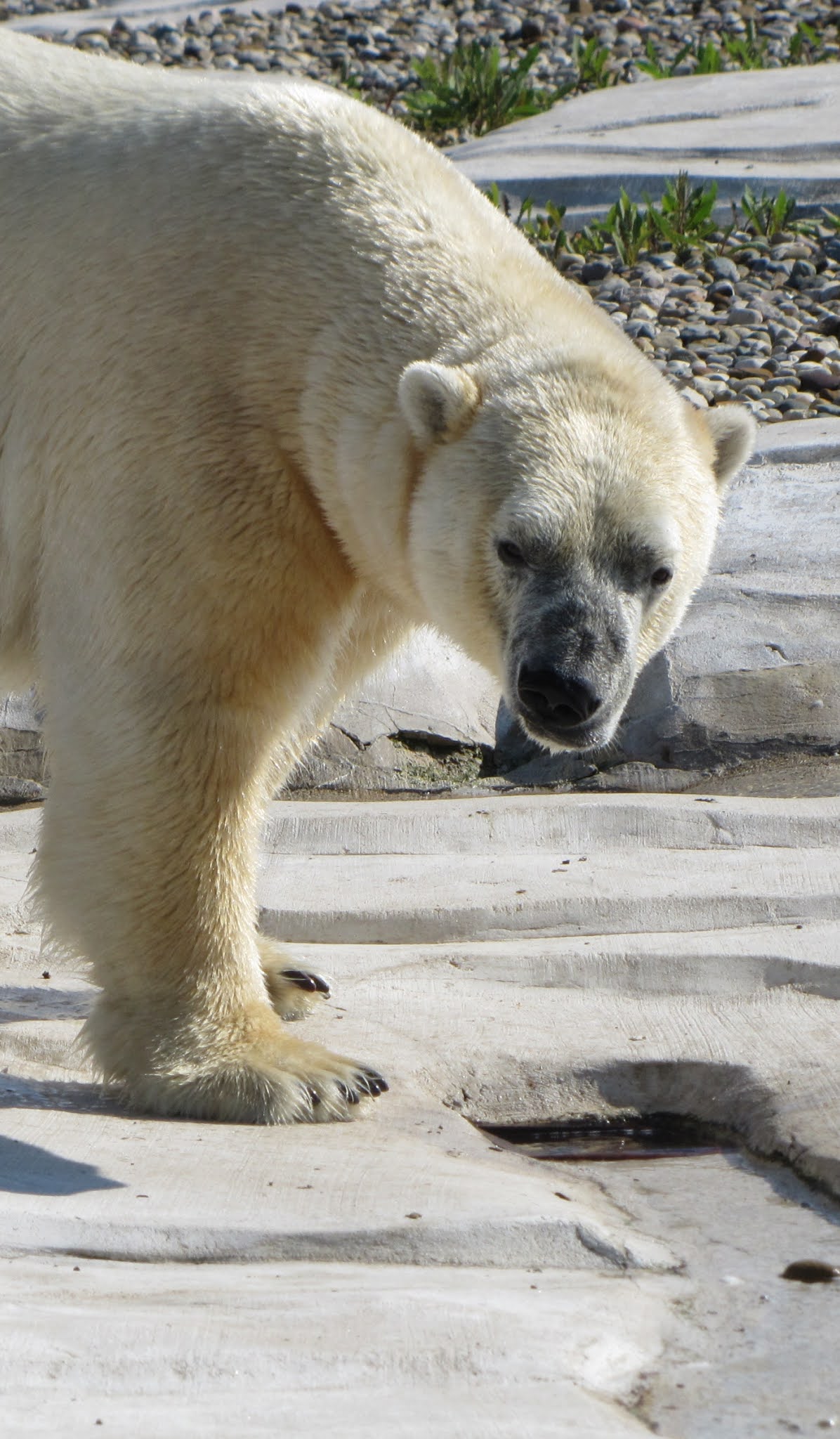
At almost 14 years of age, Kali is a lucky guy, with two girlfriends and living in the Detroit Zoo in one of the best polar bear habitats in the world. He spends his days napping, enjoying interesting snacks, wandering around the meadow in the tundra area, swimming through caves in the ice pack's saltwater pool, and watching his companions Suka and Haley swim and play nearby. 

Kali marches around the tundra area in Detroit Zoo 
He has gone through many years living alone up to this point, however. 


Kali looking rather solemn after being awoken from his nap

Kali profile


His story begins with a terrible tragedy. Kali was born in a snow den in the wilds of Alaska, near Point Lay on the Chuckchi Sea coast in the winter of 2012-13. His mother was larger than your normal female polar bear, so much so that a native Alaskan hunter mistook her for a male and shot her during a subsistence hunt. Upon examining the bear's body, the hunter realized that he had killed a nursing mother. The hunter knew there was at least one hungry cub out there, in desperate need of help and some good luck. The hunter followed the mother bear's tracks back to the den and found a tiny cub, tucked the baby into his coat, or maybe his backpack, giving him a ride to safety on his snowmobile. This was in March of 2013. 

Baby Kali in Buffalo

Kali's name comes from the native word for the village of Point Lay. 

Kali and Luna in Buffalo Zoo

Kali was turned over to the US Fish and Wildlife Service, and taken to the Alaska Zoo, where he was bottle fed and cared for. The Alaska Zoo had done this before, for Qannik, who now lives in the Louisville Zoo. 

Kali standing tall in Buffalo Zoo

In May, the cub was flown to the Buffalo Zoo in New York State, where young Luna was being raised by the keepers after her mother Anana neglected and ignored her. Luna was exactly the same age as Kali, and could use a playmate as well as helping Kali develop his bear skills. Both mother Anana and father Nanuq had moved to other zoos long before Kali arrived. 

Little Kali, next to the zebras.

I visited Luna and Kali in the summer of 2013, and found the two youngsters wrestling and playing up a storm. Because the Buffalo Zoo had just started construction of new polar bear habitats on the spot of the old bear grottos, the little bears were given a fenced in area next to one of the buildings, where they had constant supervision, a shallow pool, a semblance of a forest, shade, room to play and lots of toys. And of course they had each other. 


Luna and Kali
While Kali spent much of his time playing with Luna or on his own, he also had to get over the trauma of losing his mother. He comforted himself by sucking on his paws, and humming  loudly like he had a little motor running, as cubs do when they nurse. 


Kali and Luna at play. They had such good times.
The cubs were the star attraction of the zoo, with lots of folks wanting to get a glimpse of this cute little odd couple. 

Baby Kali
Everything seemed to be going well for these two cubs, until they were moved to the tiger enclosure. Luna fell into the moat and broke her leg, so the two cubs were separated while Luna's leg healed.

Kali at play
The playmates did have some time together once again, but soon Kali was sent off to the St. Louis Zoo, which had just opened up its fantastic new polar bear habitat Polar Bear Point, in May of 2015, and needed an occupant. 

Kali in St. Louis, 2016.
He settled into his new home in St. Louis just fine, and was a popular guy with all the zoo visitors, but he was all alone. The Department of Fish and Wildlife had rules that allowed rescued cubs to be housed and cared for in zoos, but they were not to be allowed in the breeding programs, so Kali was not to have a companion. 

Kali loved the kids in St. Louis. This photo was from 2016,
Kali is a very sociable bear, and loved interacting with all the visitors in St. Louis. His people-oriented personality probably comes from being fed and raised by humans in the Alaska Zoo and then the Buffalo Zoo. Kali is still beloved in St. Louis. 

Kali on his favorite ledge,
where he liked to sit and watch his fans in St. Louis


Kali with his tire in St. Louis. 


Kali in 2017 in St. Louis

Because of various political pressures, and the fact that polar bear breeding in the US zoos was in great need of fresh genes, the ban on rescued polar bears breeding was lifted several years ago. Kali, and Qannik too, could now be part of the breeding program.

In an exchange, the 2 year old twin boy cubs Kallik and Kallu from Toledo were sent to St. Louis in early 2025, and Kali was sent to Toledo, in hopes that he would be a breeding partner for the twins' mother Crystal, even though she is probably too old for such a venture and Kali was not prepared to deal with a female and inexperienced, having been alone for so long. 

Crystal and her twin sons, Kallik and Kallu
on their second birthday in Toledo. 

In Toledo, it was not a love match. Crystal actively avoided Kali, and Kali did not know how to deal with this mature polar bear lady. 

The queen mother, Crystal.
By the start of the next breeding season, it was arranged that Nuka, the father of Crystal's last set of twins, would come back to Toledo from Detroit, and Kali would go to Detroit to try his luck with Suka and Haley, the ladies there. At least they knew Crystal could get along with Nuka. 

The handsome mature Kali in Detroit

In Detroit, Kali had to figure out how to impress these two females, and he had no idea. There was some breeding going on with both girls, but this was all new to Kali, and those watching what was going on expressed doubts that he was up to this new challenge. He was an inexperienced boyfriend, but he was trying. There may be cubs this year, however chances don't look good. Maybe we will be surprised. Kali has learned a lot about dealing with the ladies, and should do much better the next breeding season. 

Haley in front, Kali strolling away.

After breeding season, the girls pretty much avoided Kali, but things are getting better. Haley especially has been trying to socialize Kali. After all, he hasn't had much experience as an adult polar bear dealing with other polar bears. He has learned a lot in his first breeding season about courtship. And even this summer there have been times when all three, Kali and his two lady companions, have been seen playing together in the freshwater pool.

Kali is looking great. He weighs in at a magnificent 1500 pounds. His fur is thick and clean, and he walks around like he owns the place. He has gained a lot of confidence in the last year. Hopefully his wild genes will be passed on with successful breeding seasons to come.


Kali atop the underwater viewing tunnel


Haley, lower left, with her eye on Kali, in the viewing tunnel


I noticed a little bit of the Baby Kali mannerisms when I visited the Detroit Zoo. When he stood atop the tunnel, I saw that he moved one of his paws in the same waving way he did when he was a baby, in a comforting move. Very sweet. 

Kali repeatedly waves his paw while atop the viewing tunnel, which may be a reminder of a comforting movement from when he was a baby in Buffalo, when he was sucking on his paw. 


Kali's paws, as he stands on the viewing tunnel. 

Detroit Zoo's Arctic Ring of Life has two separate areas, Pack Ice and Tundra, which is a beautiful meadow.

Kali and his friends are living in one of the best polar bear zoo habitats in the world, The Arctic Ring of Life, a 4,2 acre park divided into the grassy hills of the Tundra with a 30,000 gallon freshwater pool, and the Pack Ice which offers a 300,000 gallon salt water pool dissected with a 70 foot underwater viewing tunnel for visitors. Currently, the bears have access to all the habitat, but it can be divided when needed, as when cubs are born. 

Thursday, March 6, 2025

Big changes for Crystal's family

Crystal in summer of 2023
The big news this week is the switcheroo of bears between the Toledo Zoo and the St. Louis Zoo. The move was announced after the fact. It seems that last Friday, February 28, was the last day that twins Kallik and Kallu were out in the public view in Toledo. The next thing we knew, the move had already taken place and the two year old boys were in St. Louis. 


Kallu and Kallik


Two year old Kallu and Kallik in the pool in Toledo.

In exchange, wildborn Kali (pronounced Cully) made the trip from the St. Louis Zoo to the Toledo Zoo, where the boys' mother Crystal was waiting for her new companion. 

Kali gets an ice treat, summer of 2016 in St. Louis.

Kali swims in St. Louis.
The Toledo Zoo is now repairing and upgrading their polar bear habitat, so no polar bears can be seen. In the meantime Kali will quarantine and then he and Crystal can be introduced to each other. I am not sure how much of this year's breeding season will remain by the time they meet.

Baby Kali at the Buffalo Zoo

Kali's story got off to a sad start. He was born in the winter of 2012-13 in the wilds of Alaska. A hunter mistook his mother, who was very large, for a male and killed her. Realizing that this was a nursing mother, the hunter retraced the mother bear's steps to the den and found young Kali. The hunter loaded the cub onto his snowmobile, and brought him to civilization. Kali lived in the Alaska Zoo for awhile, gaining weight and strength, and then moved to the Buffalo Zoo, where a young girl bear Luna needed a playmate.

Kali and Luna play together


Luna and Kali splash around.


Young Kali

 Luna's mother Anana was not a good mother, and ignored her, so she had been raised by keepers. The two young cubs, about the same age, hit it off and had a couple of years teaching each other to be bears.

Kali all grown up
Kali moved to the St. Louis Zoo, where he has been living alone ever since. He has grown to be a very large male. As property of Fish and Wildlife, he had been banned from the breeding program until about a year ago. His wild genes are valuable. So he has come to Toledo to find Crystal. If she is interested, we will see.

Crystal with Suka and Sakari in 2013


Crystal turned 26 years old this past November, which is at the far edge of breeding capability, but she is a proven breeder, having raised nine cubs, and the US has only three proven female breeders. The other two are her daughters Suka and Aurora, and they are already with mates.

The oldest polar bear to give birth, to my knowledge, was Uslada of the zoo in St. Petersburg Russia. Uslada was born in November of 1987. Just weeks after she turned 26 years old, she gave birth to her 16th cub Zabava in 2013.

Crystal nursing Sakari and Suka in 2013

If Crystal were to give birth next fall, it would be around the time she is turning 27 years old, so she would become the oldest. 

Crystal nursing Bo in 2019

Becoming a mother is exhausting for a polar bear. There are months of denning awaiting birth, and then months afterwards of not eating but having to produce milk for the cubs. Then when the cubs are old enough, the polar bear mom has to teach them important lessons through play, and guard them to keep them safe. If it is a single cub, mama is the only playmate, so that is even more demanding.

Crystal and probably mama's boy Kallu.

Crystal is the mother or grandmother of all the polar bears under the age of 10 in the US, except for Kava, a wildborn rescue female now in the Alaska Zoo. There is a problem finding suitable mates who are not closely related, and any cubs resulting from this new pair will also be offspring of Crystal, so I am not sure what we will gain, even if the cubs carry Kali's wildborn genes.

Crystal was born in Monde Sauvage Safari Parc in Aywaille, Belgium in 1998, where she had an older sister, Blanche. Crystal came to Toledo when she was about a year and a half, in the spring of 2000, just as the fine new polar bear habitat at the Arctic Encounter was opening. A young male polar bear named Marty was waiting for her. Another female bear, wildborn Nanuyaak, usually called Nan, arrived in 2001.

Aurora and Anana in Columbus in 2011

Crystal raised twin girls Aurora and Anana, born to Crystal and Marty in 2006. The girls moved to a beautiful meadow habitat at the Columbus Zoo. Aurora has become mother to Nora, twins Nuniq and Neva, and Kulu. Anana gave birth to Amelia Gray. Sadly, Anana passed away a few years ago.

Crystal and baby Siku
Next was Siku, born in 2009. Crystal did a fine job of mothering him, and in the fall of 2011 he moved to the Louisville Zoo where he lived next to but not with his grandmother Arki, who had retired from Brookfield Zoo. Siku currently lives in Lincoln Park Zoo in Chicago with Talini.

Suka and Sakari in 2013
In 2012 boy and girl twins Sakari and Suka were born. Sakari now lives in the Buffalo Zoo with Luna, and Suka lives in the nearby Detroit Zoo with Nuka, who is the father of Crystal's last set of twins Kallik and Kallu, as well as Suka's twins Laerke and Astra. 

Crystal and Hope in 2016

Hope was born in 2015. She moved to Hogle Zoo in Salt Lake City where she played with Aurora's daughter Nora. Hope now lives in Brookfield Zoo in Chicago with Hudson, brother of Marty.

Crystal and Bo in 2019
Borealis, usually called Bo, was born in 2018 and in 2020 moved to Henry Vilas Zoo in Wisconsin. Just last year, he moved to the Louisville Zoo, where he is companion to wildborn Qannik, who has now gotten permission from Fish and Wildlife to associate with boy bears.

Marty died in late 2021. Since Crystal's daughter Suka had given birth to twins in nearby Detroit, Suka's mate Nuka was on his own, so he was brought to Toledo, where he and Crystal got along very well.

Kallu and Kallik in June of 2023.
Twin boys Kallik and Kalu were born in late 2022. Nuka had gone back to Detroit, so it was just Crystal and her cubs. She took excellent care of the babies, but probably was happy they were twins and could entertain each other while she rested and watched. She seemed tired.

Crystal raised the boys for two years. Recently she showed signs that she was getting annoyed with them, and so they were separated. Now the boys are off on a new adventure in St. Louis. 

Crystal was ready for her retirement, but now there is a new suitor who has arrived, and we will see what happens.

Yes, Crystal is 26 years old.


Birthday parties for Crystal and the cubs last November. A party on Sunday for Crystal and a party on Monday for the boys.
Nan, now the oldest polar bear in a US zoo, lives in the Como Zoo in Minnesota with Neil, the oldest male polar bear in the country, and Crystal's grandson Kulu. 

Relatives in Europe

For those wondering about Crystal's overseas relatives, her sister Blanche died last year, but her daughter Qannik still lives in Monde Sauvage. Blanche's son Nanook lives in Skandinavisk Dyrepark in Denmark, and there he has a son Siku and a daughter Nuno, who also has twin daughters, Nivi and Anori.  Nanook's son Nanu lives in France.  


Saturday, April 24, 2021

Update: Anana's death was from natural causes

Anana in Brookfield Zoo, Chicago


The news of the tragic death of Anana at the Detroit Zoo on February 8, just a little over two months ago was all the more heartbreaking to think that another much loved bear, Nuka, had killed her during attempted breeding. Anana was adored by zoo visitors from the Brookfield Zoo, Buffalo Zoo, Cincinnati Zoo, and her final home at the Detroit Zoo.

It is a relief to know the truth now, with news of the results of the autopsy.

An independent commission of experts has studied what led to Anana's death, and their results were shared this week with Detroit Zoo members through an email. 


Anana in Cincinnati


The following was sent out in an email to the Detroit Zoo members this week from the Detroit Zoological Society.

DZS recently completed an in-depth review into Anana’s death and, working with veterinary pathologists at Michigan State University, discovered that she died from advanced heart disease. She was not killed by male polar bear Nuka, as was originally believed. The DZS’s Animal Health External Review Panel, a group of experts in veterinary and human health, endorsed this conclusion.
Analysis of Anana’s heart tissues showed that she experienced acute heart failure or a fatal arrhythmia before or during breeding attempts. It was impossible to know that she had a cardiac condition called multifocal myocardial fibrosis, as she showed no clinical signs and a 2020 medical examination noted no abnormalities in her heart function. Wounds on Anana likely resulted from Nuka holding her with his teeth, as is typical during polar bear breeding. He was also observed moving her around the habitat after she became unresponsive, possibly because he was confused by her behavior.
While DZS continues to mourn Anana’s loss, the polar bear staff is focused on caring for Nuka, as well as female Suka and her 6-month-old cubs. Laerke (the cub being reared by staff) is living in the polar bears’ building, but is separated from the other bears while she gets to know them from a distance. Suka and Astra (the cub she is raising in the maternity den) will soon be exploring the Arctic Ring of Life’s Tundra habitat.

Anana


From the start, Nuka was presumed guilty, but now has been found innocent of causing Anana's death. It sounds like the wounds were inflicted upon her face and neck by Nuka's efforts to wake Anana up after her heart failure.

Nuka is the father of the Suka's twins and we will be able to see these cubs, one raised by their mother Suka and the other by keepers, in the coming weeks at the Detroit Zoo.  A shadow over the happy events surrounding the new cubs has been lifted with the news that Anana's death was from natural causes. 

Anana was born at Hogle Zoo in Salt Lake City on December 12, 2000. The petite lady bear, weighing in at only 450 pounds, had one daughter, 8 year old Luna, now living in the Buffalo Zoo with Suka's brother Sakari. Anana died of heart failure in Detroit on February 8, 2021.


Nuka, father of the cubs

Suka, mother of twins, in Detroit