Thursday, June 25, 2020

Kulu is one big little guy

Kulu

For polar bear fans, 2020 has been a disappointing year so far with zoo trips out of the question for so many months, and Europe not even a possibility. With so many cubs to potentially visit in Europe, and even Flocke's triplets in France, sadly all travel plans had ground to a halt. I hadn't been to a zoo since Qannik's birthday party in Louisville in January.


But there is one cub I have really been looking forward to meeting, and he is very close by. Kulu is the only cub in the United States, well, really the only cub in this hemisphere, in a zoo setting anyway.

Kulu and Aurora on the big rock

When would I get my chance to finally meet this little guy, who was born Thanksgiving Day in 2019?

Kulu's father Lee


I had gone up to Columbus in November of 2019, it seems so long ago, to see Lee, father of the cub.

By the time Kulu was six months old, the Columbus Zoo had been closed for three months. Kulu had gotten used to the outside area with no one to watch him but his mother and the keepers. The zoo finally announced they would open on June 12. I got my timed ticket for 10 a.m. on Friday, June 19. I would finally get to meet Kulu. 

I was disappointed that, although the zoo had told the public that masks were highly recommended, about 90 percent of the people were not wearing a mask or keeping their distance.  The zoo was keeping the attendance fairly low, and I had a KN-95 mask, so I felt fairly safe, but it still made me wary, and it was harder to get photos with so many people crowding to see darling Kulu.

Kulu bites his paw

Swimming Kulu 

Kulu with his Blue Ball 

Blue Bucket

Kulu 

Kulu watches everything

Kulu balancing on the logs

Kulu isn't a cute little tiny cub anymore. Well, he is still cute, but he's a roly poly strong little guy weighting 180 pounds (about 82 Kg) at not quite seven months of age.

Kulu is growing every day. He is such a big boy


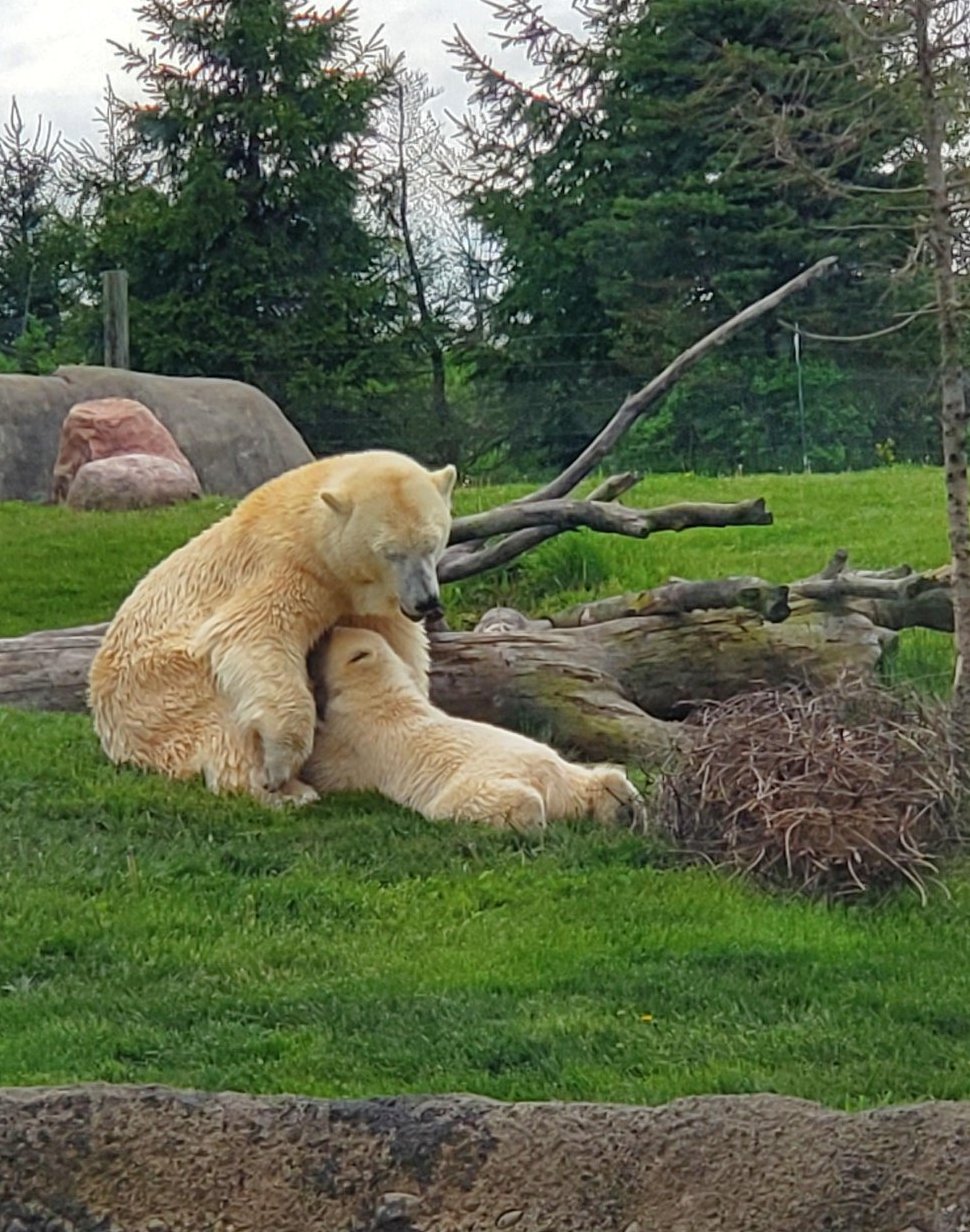
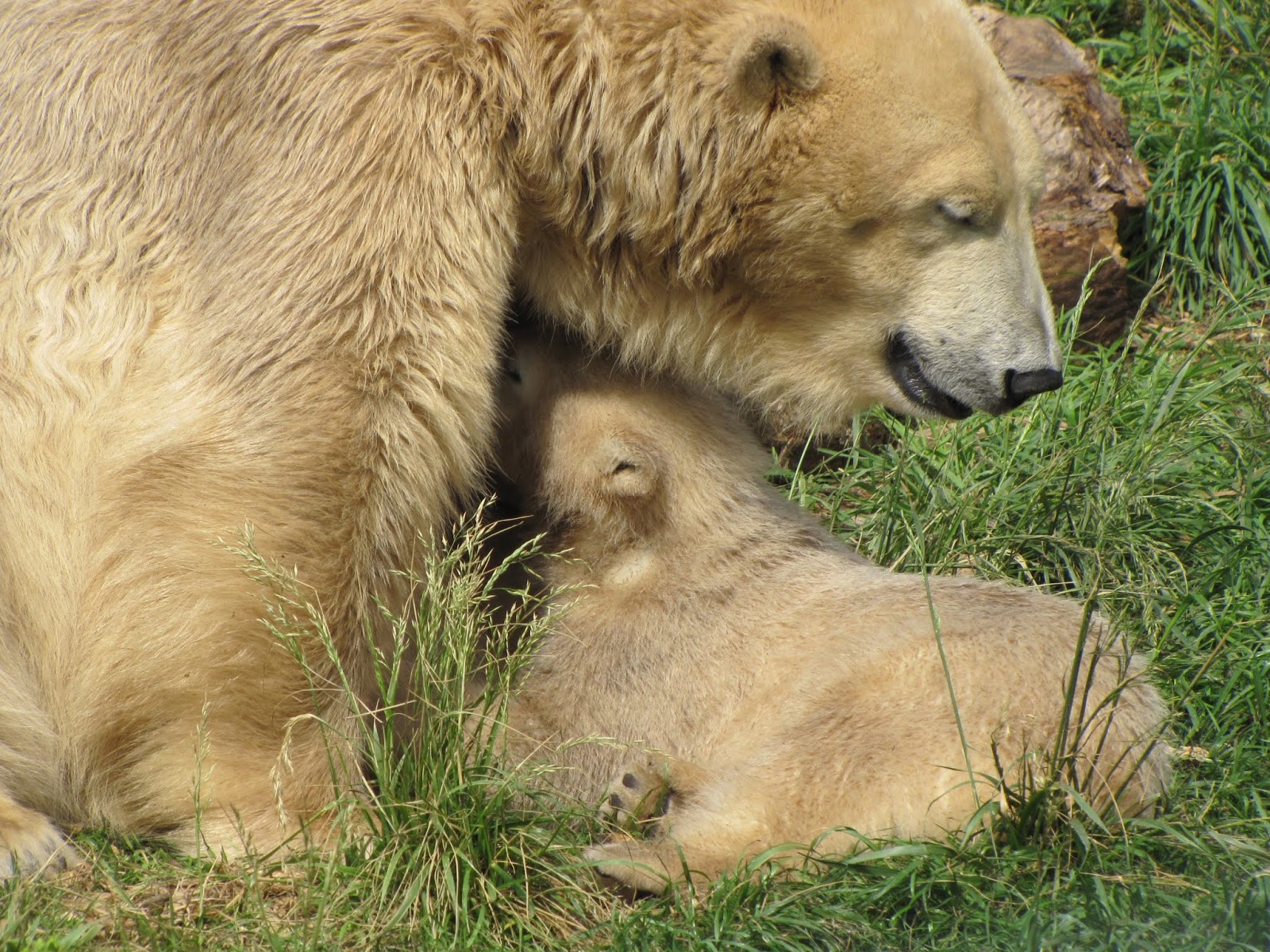
He followed his mom Aurora around for awhile. Sometimes they would disappear into the private area on the left, and I think Aurora prefers to feed her cub without an audience.

Mother Aurora on the big rock pillar

When Mother Aurora decided to climb onto the big stone pillar over the diving pool for a nap, Kulu went off on his own, being very confident and independent. He played with his toys, especially a small red plastic carton. He also likes his blue ball, his red top, and his red block. I imagine his keepers change his toys out frequently to keep him amused.


Kulu chews

Kulu likes the smell ports under the stone pillar and the wooden dock too. The keepers can disperse interesting perfumes and other smells there to keep him interested.

Kulu at one of smell ports, wearing some seaweed

The cub also keeps an eye on the live trout. His mother is trying to teach him to catch the fish, and he dives in to try, but so far, has not been successful. Still, he tries.

There's Mother Aurora, and maybe a fish?


Looking for his red toy or a fish?

Splash! Kulu isn't so good at diving yet.


Trying for another fish.  And trying to improve his diving form.

He is not an adept diver. He usually just falls headfirst into the pool, but he does love swimming around, trying to catch the elusive fish. 

Mother Aurora strolls as Kulu plays


As Kulu plays, he keeps an eye on his mom, just checking to see that she is still there. Aurora is always aware of where her little cub is, even when she is napping.

Kulu


Going for the Blue Ball

Kulu trying to pay equal attention to all his toys

Kulu loves to swim, spending most of his time in the water


Aurora is an experienced mother. She gave birth to her first cub Nora in 2015, a cub who was raised by keepers and went to another zoo before she was one year old. Nora is now at Hogle Zoo in Salt Lake City with her Aunt Hope, Aurora's little sister of the same age as Nora. 

In 2016, Aurora gave birth to twins, Neva and Nuniq, and her twin sister had Amelia Gray. The twin sisters and their families alternated days in the public viewing area, and elderly Daddy Nanuq came out at night. This time Aurora took great care of her cubs.

After old Nanuq passed away, and Neva and Amelia Gray moved to Maryland and young Nuniq moved to Madison Wisconsin, a new male bear arrived in Columbus to be a companion for twins Anana and Aurora. Lee was born in 1999 the Seneca Park Zoo in Rochester NY. Lee's mother was Aurora, and his father was the late Yukon, twin brother of Berlin, born in the Cincinnati Zoo in 1989. Lee had moved around a bit, had been in Lincoln Park, Milwaukee, Detroit and Denver, and had never fathered any cubs before Kulu. His genes are especially valuable as his sisters Anoki and Hayley, and twin sister Anana (of North Carolina) have not produced cubs. He is a descendant of Olaf and Olga, through Shep. He is also descended from Bruno of the Memphis Zoo, so is related to many of the European polar bears.

The Columbus Zoo currently alternates having Aurora and her cub Kulu in the public exhibit on one day, and Lee and Anana on the next day. The schedule is subject to change. The pair not on public view has a spacious hidden enclosure with pool.


Kulu keeping his eye on everything

He is a curious cub


Kulu has a secret sheltered area under the big rock pillar where he can hide
and still watching everything, including his mom up top.

Little Kulu asks his mom to wake up
 and come into the water to play


A little wet after a dip in the pool. Shaking it off.

Aurora's grandma Arki (her father Marty's mother) loved lettuce sandwiches, and it seems that Aurora does too. Aurora gobbled down the bread and the Romaine lettuce. Kulu had some too. 

Aurora has some bread thrown into the water


Romaine Lettuce, a favorite

Like her late Grandma Arki, Aurora likes lettuce

Kulu wants some too

Kulu steals a few leaves

Yes, she loves her lettuce

Kulu loves his mom

Lettuce is good for a mask, too. We are supposed to wear masks.

It was such a treat to see Kulu and his playful antics. Mother Aurora was fun too. She loves to play and can be a silly girl.

The Columbus Zoo has a docent stationed in the polar bear viewing area, so I was glad to have someone to answer my questions.  I hope to get back to Columbus soon to see just how much Kulu has grown. He's the only cub I can go see for the time being, so he had better get used to my visits. 

Bye for now, Kulu 

Saturday, June 20, 2020

Happy Father's Day to Victor

Victor

Happy Father's Day to Victor.

Victor was born in 1998 in Zoo Rostock to Churchill and Vienna. His brother Vitus has been proven sterile. His sisters Vilma, Valeska, Venus and Victoria have produced cubs, but Victor has outdone them all, with 13 offspring. He is now retired comfortably at Yorkshire Wildlife Park in the UK, where he lives with his grandson Pixel, and three other male polar bears: Nissan, Nobby and Raspi.

His first son Rocky was born in Ouwehands Zoo in the Netherlands  in 2002, when Victor was just four years old. The mother was a wildborn bear named Vera. Rocky now lives in Belgium. He is the father of a daughter named Qannik.


Huggies


Henk

In 2005, triplets were born in Ouwehands to Huggies. Henk is now in Nuenen, and has fathered three sets of twins there. Ewa lives in Sweden in Orsa Bear Park, but has no cubs. Jelle lives in St. Felicien in Canada, where he fathered two cubs, Shouka and Kinuk, with two different mothers, Milak and Aisaqvak, in 2018. 


Sprinter

Victor's son Sprinter, who looks a lot like his grandfather Churchill, was  born to Huggies' daughter Freedom in Ouwehands in 2007. Sprinter is a new father in the zoo in Hannover. Milana gave birth to a daughter, Nana.

Walker, on the right, with his friend Arktos at Highlands Wildlife Park

In 2008, It was Huggies' turn again to have Victor's cubs. She gave birth to Walker and Swimmer, named for diapers. The cubs' birth was filmed and used in a famous TV documentary. Swimmer was much smaller than Walker, but seemed fine. However, only a week after their public debut, in Mid-March, Swimmer had a medical emergency. Something had burst, and he died in the pool. This condition may be why he had been so small, about a third the size of Walker. Huggies and Walker grieved for a long time. 


Sesi with daughter Nanuq
Another set of Victor's twins, Sesi and Siku (now Taiko), were born in 2010 to mother Freedom, Huggies' daughter. Sesi now lives in Mulhouse France, where she had a daughter Nanuq in 2017. Taiko also lives in France.

Lynn with Imaq in Copenhagen

Luka in Wuppertal

Victor's twins Lynn and Luka were born in 2011 in Ouwehands to Mother Huggies again. Lynn now lives in Copenhagen and had a daughter Imaq last year. Luka lives with Anori in Wuppertal.


Akiak and Sura as cubs

Freedom with cubs Sura and Akiak

Victor's last cubs, Akiak and Sura, were born to Freedom in 2014. Akiak now lives in Rostock's newly rebuilt polar bear habitat. Sura still lives in Ouwehands.


Victor's grandson Pixel lives with his grandpa at Yorkshire Wildlife Park, which has just reopened


Victor is king at Yorkshire Wildlife Park


Happy Father's Day to a great dad and grandpa.


Sunday, June 7, 2020

The naming of polar bear cubs

Mother Malik with one of her two cubs at Aalborg Zoo
Photo by Jeanette Johnsen

We have had quite a population explosion of polar bear cubs this season, and they have been making their public debuts, maybe a little late due to the corona virus, and getting names. I have counted a dozen cubs in Europe, and one in the USA. I think there were two born in Russia as well.

I thought it would be a good idea to list the new cubs with their names, in the order of their birth. There are four boys and nine girls.

Three of the cubs were fathered by the Russian bear Nord. In Copenhagen, he fathered Imaq last year. This year he fathered Noel's daughter Inuvik in Copenhagen, then moved on to Aalborg Zoo where he lingered long enough to father twin girls with Malik, and now he is living in Skandinavisk Dyrepark. Maybe more Nord cubs next year? 

Since I haven't been able to travel, I rely on photos from my polar bear friends, and the facebook pages of the zoos.

Finja. Photo from the  Zoo Vienna Schönbrunn facebook page
Finja
(1) The first cub of the season was born to Nora and Ranzo in Zoo Schoenberg in Vienna, on November 9, 2019. She has been named Finja (pronounced Feenya). An American connection: Ranzo's grandmother was CW, born in the Memphis Zoo. CW was sister of Chinook, mother of Seneca Park Zoo's Aurora; Anana of the Cincinnati Zoo, now in Detroit; and Denali in Japan.

***
Nana
(2) Milana in Hannover had a cub with Sprinter as the father on November 20, 2019. The little girl has been named Nana. An American connection: Sprinter's mother is Freedom, grandaughter of CW, born at the Memphis Zoo. Again, some American cousins.

***
Yuka, the boy, and Yura, the girl, at Ouwehands.
Photo from the zoo's facebook page
Yuka and Yura
(3-4) November 27,  2019, Freedom had twins with the Russian born Wolodja at Ouwehands in lthe Netherlands. Yuka is the boy, Yura is the girl. American connection: Freedom's grandmother was CW, born at the Memphis Zoo.  More American cousins.

***

Kulu and his mom Aurora at the Columbus Zoo.
 From the Columbus Zoo facebook page
Kulu
(5) In the U.S.A, the only cub born this season is Kulu, son of Aurora and Lee, in the Columbus Zoo, on November 28, 2019. This is a fourth cub for Aurora, a first for Lee.

***

Imaq and Inuk at Aalborg Zoo. Photo by Jeanette Johnsen
Inuk and Imaq
(6-7) Malik had triplets on December 5, 2019, but lost one, so now it is twin girls in Aalborg, with father Nord. They now have names Inuk and Imaq. This may end up being rather confusing, as Nord fathered a daughter named Imaq with Lynn in Copenhagen the previous year. 


***

Mother Noel and baby Inuvik, on her first day out.
Photo by the Copenhagen Zoo
Inuvik
(8) Noel gave birth to another of Nord's daughters on December 6. The little white bundle has been named Inuvik. She is quite the handful for mother Noel and the keepers. 

***

Elsa and Anna at Zoo am Meer. Photo by Birgit Born.
Anna and Elsa
(9-10) In Zoo Am Meer in Bremerhaven, Germany, Valeska and Lloyd had twins on December 8, 2019. They have gotten wonderful names for little ice princess sisters, Elsa and Anna from the movie Frozen.

***

Flocke's triplets. Photo from Marineland's facebook page
Indiana, Yuma and Tala
(11-12-13) Sometime between Christmas and New Year's Day, Flocke and Raspi had triplets in Marineland, Antibes, France.  The two boys are Indiana and Yuma, and the girl is Tala. Father Rasputin has relocated at Yorkshire Wildlife Park in the UK.

***
Choosing names

I believe that every cub should be given a unique name, and that is often the case. Sometimes zoos don't think beyond their own facility, and don't worry about duplicating names, but we all know that almost every cub born in a zoo will move on to another zoo. It's nice if they each have their own unique name, since each bear is special. But it also prevents confusion. What if bears with the same name end up living at the same zoo?

In the USA, with a population of just 44 bears, there are three polar bears with the name of Anana, and people struggle sometimes to keep them straight.  

In my files, I find seven Snowballs, five Olafs and four Olgas, although all are gone now. There have been seven Auroras, with two in Canada and one in Columbus is still around. In fact the Aurora in Columbus is the mother of the only zoo cub we have this year in the Western Hemisphere.

There is an American Siku, born in Toledo Ohio, whose Belgium born mother Crystal is sister of Blanche, grandmother to Danish Siku, so these two Sikus, although on different continents, are close cousins. 

A third Siku was born in Ouwehands in the Netherlands with twin sister Sesi, but when he moved to France, his name was changed to Taiko, maybe so he would have his very own name.

Another overused name is Nanuk, Nanuq or Nanook, used for both male and female bears. I have counted at least 13 Nanuqs and variants of that name. 

A few years ago, the American wildborn Nanuq fathered twins in the Columbus Zoo, and the son was name Nuniq, as a variation and a tribute to his father, but still an original name.

Over the years, some bears are named after their fathers, as in Herman, and Herman II.

When Huggies had triplets in Ouwehands, the cubs were named Henk, Ewa and Jelle after the three keepers, which is a lovely tribute.

A few years ago, Frimas gave birth to twins, who were thought to be boys, and they were named after a popular Dutch singing duo, Nick and Simon. When the cubs turned out to be girls after all, their names were changed slightly, the Nicky and Simona.


There have been some instances of names being given in response to a business sponsorship, as with Kimberly Clark sponsoring the rescue of Huggies, the car company Mercedes sponsoring the rescue of problem Canadian bear Mercedes and her relocation to Scotland, and little soccer playing Hertha in Berlin. And  Kometa in Zoo Brno, in honor of their local soccer team.

In a touching tribute, Little Charlotte of Nuremberg (Hannover, now Karlsruhe) was named in honor of a devoted polar bear fan who had passed away. 

Zoos often run contests to name the cubs, with the choices narrowed down for voting. And zoos often have a celebration to announce the name, with big colorful banners and treats for the mother and cub(s). 


The bears have their public names, recorded in the studbook with unique numbers, and every bear gets a microchip so they won't get the bears mixed up.

I have also heard tell that keepers have their own secret names for the bears so they can get the bears' attention, and the public doesn't know these special names.


All the zoos with new cubs have already opened or will do so by the end of June. Those months of quietly playing and growing without fans are mostly over. Due to the pandemic, I cannot visit the European cubs for awhile, but very soon I will check up on Kulu in Columbus, not far away at all.


Sunday, May 10, 2020

Happy Mother's Day to Flocke


Flocke and her first cub Hope, who was born November 26, 2014.


It made worldwide news. Flocke had given birth to triplets, and four months later, they are still doing great! 


Flocke and her newborn cubs, photo courtesy of Marineland

All in all, the end of 2019  was an amazing polar bear birthing season, with a dozen cubs born in Europe, and several in Russia. Even the U.S.A had a cub (in Columbus again, of course). The remarkable story, however, was Flocke and Raspi's little family. Everyone would want to come to the French Riviera to meet them.

Cruel fate, in the shape of a worldwide pandemic, has intervened, and Marineland is closed through at least the end of June. I was to have visited during the first week of May, taking lots of photos of this little family, followed by another trip to see the rest of the cubs. Instead, I must be satisfied to see photos and videos posted by Marineland, and hope for a visit maybe next spring?

One European cub did make her public debut before the lockdown. Fans could visit little Finja in Tiergarten Schoenbrunn in Vienna in late February.

Just recently a few of the other cubs could be met, although there are great restrictions in those zoos. Fans can visit Milana and Sprinter's daughter in Hannover, and the twins Anna and Elsa in Zoo am Meer in Bremerhaven are now receiving visitors along with their parents Valeska and Lloyd. 

Flocke and her babies, photo by Marineland

But Flocke and her triplets remain isolated from visitors, except for those who work in the park and for a recent photo op for the press, a very limited event.

Photo by Valery HACHE/AFP


Triplets who survive are quite rare in zoo polar bears, although not all that rare in Flocke's family.

A triplet birth at the Louisville Zoo in late 1992 gave us Aquila, Aurora and Arcturus, but all three are gone now.


The Louisville Triplets, Aquila, Aurora and Arcturus.
Photo courtesy of the Louisville Zoo


Skeena with her triplets in 1993 in the Louisville Zoo.
Photo courtesy of the Louisville Zoo
Flocke's great grandmother Uslada's gave birth to all male triplets in St. Petersburg in 2002, with Bering, Malygin in China and Sedov (Commodore) in a Russian safari park now. 

Victor and Huggies had triplets (Ewa, Henk and Jelle) in Ouwehands in 2005, named for their keepers. Ewa is in Sweden with Flocke's daughter Hope and also Wilbar. Henk is in Nuenen in the Netherlands and has fathered two sets of twins. Jelle is in Quebec and has fathered two cubs.

Flocke's grandmother Simona had triplets in Moscow in 2011 (Wolodja, Zefirka and a sister who has died). Wolodja is again a new father this year in the Netherlands, and Zefirka in the Ukraine has had cubs too.

I have heard of a case a long time ago where a wild polar bear with quadruplets was seen in Russia. Even triplets in a zoo come along about once or maybe twice in a decade.
Huggies, mother of triplets Henk, Ewa and Jelle.
I took this photo in 2017, more of a grandmother now.

When Huggies' daughter Freedom gave birth to Akiak and Sura in 2014, they started out as triplets, but one of the cubs did not survive.

Malik of the Aalborg Zoo has given birth to four sets of triplets over the years, but there were early losses each time. Her first cubs were all three gone in just a few days. Her second set of triplets soon became just one cub: Augo.

On November 26, 2016, Malik again had three cubs, but only Qilak and Nuka lived. Her new set of twins, still with no names, started out as triplets, but one expired after a day. Aalborg Zoo has dencam, so we watch the drama playing out, with great disappointment but it isn't surprising since polar bear cubs have such a low survival rate, maybe only about fifty percent in zoos and in the wild. 

I am sure there may be many other examples of triplets being born, but we often don't hear about those who only live a day or two.

Flocke's story

There were those who said that Flocke would never grow up to be a proper bear, having been raised by keepers. They said she wouldn't know what to do with a cub. How could she be a good polar bear mother when she was raised by humans? 

Flocke in her ice cave with Hope in 2015
In fact, Flocke is the best mom. She was a good mother to Hope for three years, and never seemed to get impatient. And now she is mother to three young rascals, two boys and a girl. 

Flocke nursing little Hope in 2015

Flocke and Raspi in Marineland

Flocke was born in Nuremberg Germany to Vera and Felix in late 2007, and when her mother Vera, a very young mother at only 4 years old, kept dropping the cub, the zoo director to have keepers raise Flocke by hand.

Flocke needed a playmate, so when she was about a year old, a male cub of the same age arrived from Moscow. Flocke and Rasputin each had someone to play with. Right from the start, Flocke, although smaller, was the boss. The two cubs got along very well.

When Flocke and Raspi were a little over two years old, they moved to a brand new state of the art habitat at Marineland on the French Riviera, right on the Mediterranean with those lovely sea breezes. They had ice caves to keep cool, two large diving pools, and three spacious enclosures on two levels.

Flocke gave birth to Hope five years ago, and Raspi was separated from his beloved Flocke for three years, while Flocke took great care of their daughter. It was difficult for Raspi to be so near Flocke, and yet separated. He could interact with Flocke and Hope through peepholes between the two upper enclosures at water level in the pools, and sometimes through the bars between one of the upper enclosures and the lower mother-child area.

Hope, at the age of three, went to Sweden two years ago, and the two adult bears were reunited! Raspi was very happy, but they still had to be separated on occasion so that Flocke could have a break from being so passionately pursued.

All their romantic activity has resulted in triplets, just announced by Marineland. It was also announced that Raspi had moved.

 Flocke gave birth to her triplets at the end of December, and now Raspi, or Rasputin, has gone to a polar bear bachelor camp in England, so Flocke can have peace and quiet to raise the children. Raspi will be distracted by his new surroundings and new friends, away from all female bears, so he won't get frustrated during spring breeding season.

At Yorkshire Wildlife Park, Raspi will be separated from the other bears for four months, living in a spacious area previously occupied by Japanese brown bears, who have since passed away. He has a grassy meadow and a lovely pond in which to swim. By all reports, Raspi has hit the ground running, and has settled in nicely, having a great time exploring his new estate. He looks happy.

The other polar bear occupants at YWP, a recently built zoo constructed on an old farm, are patriarch Victor, himself father of triplets and many other cubs: younger male bears Nissan from Russia, Nobby from Munich, and Victor's grandson Pixel from the Netherlands. Pixel is the son of one of Victor's triplets, Henk.

Project Polar, as the polar bear area is called, consists of three huge grassy meadows with ponds and caves and rolling hills. YWP plans to develop a fourth enclosure next to the central holding area. Raspi is in another spacious area for his quarantine.

Thus the male bears can be separated, or put together for good company as their moods dictate. By and large, Pixel and Nissan are best friends and usually together. Young Nobby makes do with the company of older bear Victor. Nobby would love to play with Pixel, but Nissan can be jealous. Thus it might be nice for Nobby to have a playmate in Raspi when quarantine is over.

In the meantime, back at Marineland, Flocke can have lots of space to raise her cubs.

There is talk about Marineland giving up polar bears in a few years, but with 12 cubs born this past season, and the superior conditions of the Marineland plant, Europe will need all the polar bear homes currently occupied, and more

I wonder if Flocke might come to YWP, and the three younger males at YWP be sent to other zoos, for there will be young females needing mates. The triplets could remain at Marineland for a few years.


Flocke and Raspi, together in happy days at Marineland

I hope I get to visit Flocke's triplets before they are all grown up. Right now, the earliest I think it would be possible is next spring. 

So for today, I wish a happy Mother's Day four generations of great polar bear mothers: to Flocke, to her mother Vera, to Vera's mom Simona, and to Simona's mother in St. Petersburg Russia, Uslada.

Happy Mother's Day to the new polar bear mothers taking care of new cubs this year in Europe and the USA: Aurora in Columbus Ohio; Flocke in Antibes France; Milana in Hannover Germany; Valeska in Bremerhaven Germany; Freedom in Ouwehands Zoo the Netherlands; Malik in Aalborg Denmark; Noel in Copenhagen; and Nora in Vienna.

And a Happy Mother's Day to all the polar bear mothers who have ever raised a cub. It can't be easy taking care of those active hungry adorable little cubbies.