Showing posts with label Inuk. Show all posts

Wednesday, December 27, 2023

A snack for the Aalborg bears

Malik sits at the restaurant table, waiting for someone
 to take her order and serve her a fine gourmet dinner.

As 2023 comes to an end, one more look back at my visit to Aalborg Denmark in September.  In the wild, polar bears mostly prey on seals, and occasionally on a beached whale.

But in zoos, what do they have for dinner? They have some interesting favorites in Aalborg Zoo in Denmark, things that they would never dream of in the wild.


Fish is regularly served up to the polar bears, sometimes Salmon, sometimes mackerel,
 sometimes even trout.


Polar bears need lots of fat. Sometimes they are given lard, which the bears find yummy. Sometimes they get skin with layers of fat, and they have to work hard to get the fat off.


Malik enjoying some fatty skin the cubs just dug up out of the gravel.

Sisters Imaq and Inuk wonder how to share this fatty skin.


Children may pester their mother,
 but still are welcome in this restaurant.

Malik is still waiting to be served.


In September, our group of polar bear fans got a special treat ourselves when we we allowed to go behind the scenes and bring fruit and vegetables from a list approved by the zookeepers. Some of the vegetables came from our gardens. The bears got cucumbers, tomatoes, apples, pears, celery, carrots and more.

A special treat, corn on the cob, already shucked,
 and brought by visitors.

Three watermelons, one for each. They really like the melon.
This was the first time they had it.

Here the bears get some pears from a visitor in the polar bear group.

Grapes are good too. Like a Roman orgy.

Malik's favorite is celery.

The cubs like celery too.

Yummy carrots

Celeriac is very funny looking, but Malik loves it.
The kids are liking their carrots. Synchronized eating.


Dinner is served. It looks like Fennel and Fish are on the menu.


The favorite meal for the cubs comes from Mom.
Even though they are four years old.


Tuesday, December 19, 2023

Malik and her girls of Aalborg Zoo


Inuk, Imaq and Mother Malik.
The cub who stays on land is on the left,
 and the cub who likes the water is in the middle.

My first international trip in almost five years, and I missed Aalborg Zoo most of all. I had not yet met Malik's most recent twins, Imaq and Inuq, the offspring of the late Nord. So I arranged to spend some time in Aalborg in September, and it was a gathering of polar bear fans as well.

Here I am with Ralph from the UK, in front of one of the lower windows, as the cubs roll in the river rocks. Photo by my friend Sussi

Although the cubs, who turned four years old in November, have been chipped, with a name assigned to each chip, even the keepers seem are not quite sure which one is Imaq and which is Inuk. DNA tests have shown that both are girls. The cubs are a bit smaller than their mom, but not by much, so it is easy to mix the three of them up at times. They were still nursing in September, even at that age, so sometimes you can tell it is Malik when you can see the milk bar on her chest, or the trailing beard under her chin.

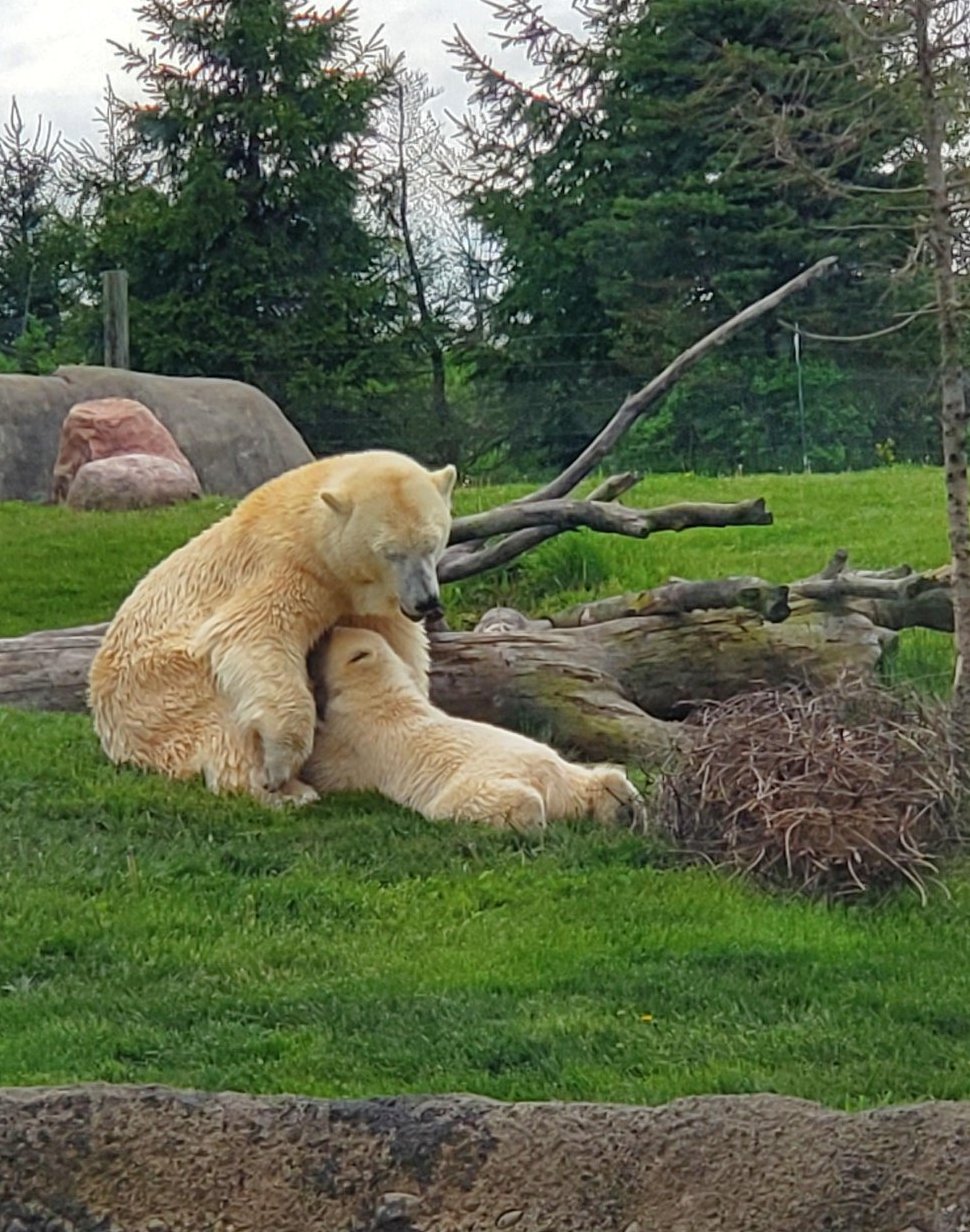
Malik still nursing her cubs, who are almost four years old.

At this age, the cubs are easy to tell apart, both by appearance and by behavior.

Malik in the middle, with the cub who likes water on the left,
and the cub who stays on land is on the right.

One of the girls has a bigger head and thicker neck, and almost a fluffy mane of fur, and she is a little darker. That one tends to hang around her mother a little more, often following Malik about, and this cub is usually on land, only goes into the water sometimes to play with her sister or fetch food, reluctantly. 

The land favoring cub on the left, with Mother Malik.
She likes to be near mom.

The other cub has a more streamlined look, sleeker fur and is lighter in color. She is the independent girl, away from mom a lot more, and tends to be in the water most of the time. 

Water cub and Land cub


Water cub and Land cub, Imaq and Inuk, who is who?

There are times when both cubs are in the water, having some wonderful splashy battles, or enjoying the many snacks the keepers throw in for them. Or they are both on land.

Sisters wrestle in the water

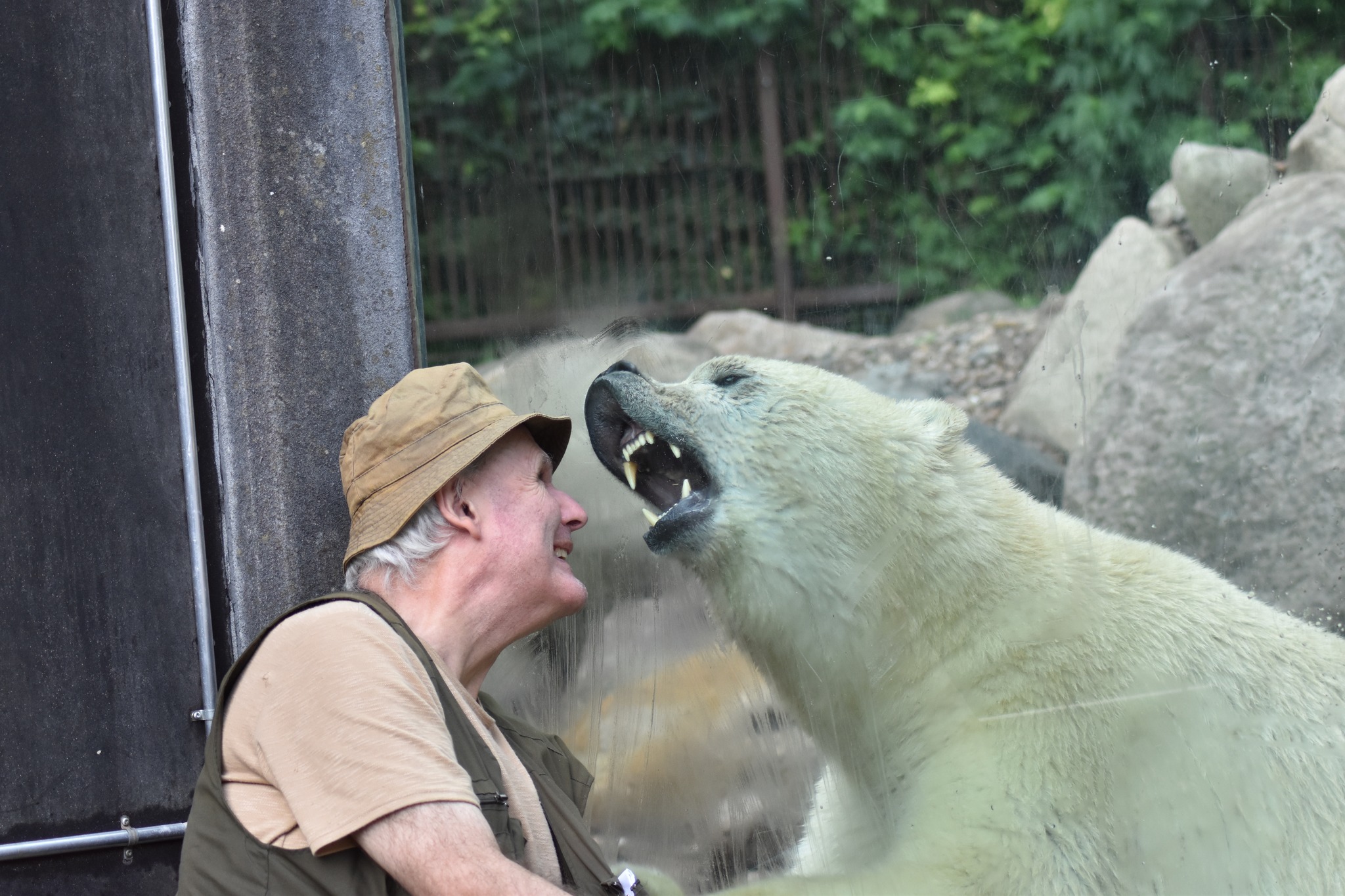
Another way to tell the cubs apart is that the cub who likes to be near mom and stay on land also really likes to interact with the visitors, especially my friend Ralph. She would spend forever sitting with him, playing with him, talking to him. We were all enchanted with the "bearmance."


The cub who likes to be on land also really likes Ralph.


                          Watch out, she wants to eat that hat.

The special gathering of polar bear fans was held on Wednesday, September 13, and it was open to anyone who wanted to come to the zoo that day. Ralph from the UK was there, as well as Marga and Hartmut from Berlin. And of course the Danish fans.

Some of the polar bear group, photo by Jeanette.

The highlight of the day came when we were allowed a behind the scenes visit to the polar bears, and we brought fruits and vegetables to feed them, approved by the keeper. We brought apples, pears and grapes, as well as carrots, cucumbers, shucked corn on the cob and tomatoes. Their favorite treat seems to be celery. 

One of the guests feeding cucumbers to the bears.

It is exciting to be so close to the polar bears, and to watch their delight as they got their special treats. I fed them the corn, giving each bear a cob, but one cub stole from her sister, and ran away with two cobs all to herself. 


The cub who likes to be in the water seems to be dominant,
 as she her sister's cob of corn and ran away.

Jeanette also brought three watermelons for the keeper to throw into the pool later. That was a big hit too.

Waiting for the watermelons

Watermelon in the water

Best to find a place to eat this, away from sister.

Chowing down


Running away with the prize. There were three melons for three bears.

Making a delicious mess. They ended up eating the rind too.


Some leftover grapes are found


Sunday, June 7, 2020

The naming of polar bear cubs

Mother Malik with one of her two cubs at Aalborg Zoo
Photo by Jeanette Johnsen

We have had quite a population explosion of polar bear cubs this season, and they have been making their public debuts, maybe a little late due to the corona virus, and getting names. I have counted a dozen cubs in Europe, and one in the USA. I think there were two born in Russia as well.

I thought it would be a good idea to list the new cubs with their names, in the order of their birth. There are four boys and nine girls.

Three of the cubs were fathered by the Russian bear Nord. In Copenhagen, he fathered Imaq last year. This year he fathered Noel's daughter Inuvik in Copenhagen, then moved on to Aalborg Zoo where he lingered long enough to father twin girls with Malik, and now he is living in Skandinavisk Dyrepark. Maybe more Nord cubs next year? 

Since I haven't been able to travel, I rely on photos from my polar bear friends, and the facebook pages of the zoos.

Finja. Photo from the  Zoo Vienna Schönbrunn facebook page
Finja
(1) The first cub of the season was born to Nora and Ranzo in Zoo Schoenberg in Vienna, on November 9, 2019. She has been named Finja (pronounced Feenya). An American connection: Ranzo's grandmother was CW, born in the Memphis Zoo. CW was sister of Chinook, mother of Seneca Park Zoo's Aurora; Anana of the Cincinnati Zoo, now in Detroit; and Denali in Japan.

***
Nana
(2) Milana in Hannover had a cub with Sprinter as the father on November 20, 2019. The little girl has been named Nana. An American connection: Sprinter's mother is Freedom, grandaughter of CW, born at the Memphis Zoo. Again, some American cousins.

***
Yuka, the boy, and Yura, the girl, at Ouwehands.
Photo from the zoo's facebook page
Yuka and Yura
(3-4) November 27,  2019, Freedom had twins with the Russian born Wolodja at Ouwehands in lthe Netherlands. Yuka is the boy, Yura is the girl. American connection: Freedom's grandmother was CW, born at the Memphis Zoo.  More American cousins.

***

Kulu and his mom Aurora at the Columbus Zoo.
 From the Columbus Zoo facebook page
Kulu
(5) In the U.S.A, the only cub born this season is Kulu, son of Aurora and Lee, in the Columbus Zoo, on November 28, 2019. This is a fourth cub for Aurora, a first for Lee.

***

Imaq and Inuk at Aalborg Zoo. Photo by Jeanette Johnsen
Inuk and Imaq
(6-7) Malik had triplets on December 5, 2019, but lost one, so now it is twin girls in Aalborg, with father Nord. They now have names Inuk and Imaq. This may end up being rather confusing, as Nord fathered a daughter named Imaq with Lynn in Copenhagen the previous year. 


***

Mother Noel and baby Inuvik, on her first day out.
Photo by the Copenhagen Zoo
Inuvik
(8) Noel gave birth to another of Nord's daughters on December 6. The little white bundle has been named Inuvik. She is quite the handful for mother Noel and the keepers. 

***

Elsa and Anna at Zoo am Meer. Photo by Birgit Born.
Anna and Elsa
(9-10) In Zoo Am Meer in Bremerhaven, Germany, Valeska and Lloyd had twins on December 8, 2019. They have gotten wonderful names for little ice princess sisters, Elsa and Anna from the movie Frozen.

***

Flocke's triplets. Photo from Marineland's facebook page
Indiana, Yuma and Tala
(11-12-13) Sometime between Christmas and New Year's Day, Flocke and Raspi had triplets in Marineland, Antibes, France.  The two boys are Indiana and Yuma, and the girl is Tala. Father Rasputin has relocated at Yorkshire Wildlife Park in the UK.

***
Choosing names

I believe that every cub should be given a unique name, and that is often the case. Sometimes zoos don't think beyond their own facility, and don't worry about duplicating names, but we all know that almost every cub born in a zoo will move on to another zoo. It's nice if they each have their own unique name, since each bear is special. But it also prevents confusion. What if bears with the same name end up living at the same zoo?

In the USA, with a population of just 44 bears, there are three polar bears with the name of Anana, and people struggle sometimes to keep them straight.  

In my files, I find seven Snowballs, five Olafs and four Olgas, although all are gone now. There have been seven Auroras, with two in Canada and one in Columbus is still around. In fact the Aurora in Columbus is the mother of the only zoo cub we have this year in the Western Hemisphere.

There is an American Siku, born in Toledo Ohio, whose Belgium born mother Crystal is sister of Blanche, grandmother to Danish Siku, so these two Sikus, although on different continents, are close cousins. 

A third Siku was born in Ouwehands in the Netherlands with twin sister Sesi, but when he moved to France, his name was changed to Taiko, maybe so he would have his very own name.

Another overused name is Nanuk, Nanuq or Nanook, used for both male and female bears. I have counted at least 13 Nanuqs and variants of that name. 

A few years ago, the American wildborn Nanuq fathered twins in the Columbus Zoo, and the son was name Nuniq, as a variation and a tribute to his father, but still an original name.

Over the years, some bears are named after their fathers, as in Herman, and Herman II.

When Huggies had triplets in Ouwehands, the cubs were named Henk, Ewa and Jelle after the three keepers, which is a lovely tribute.

A few years ago, Frimas gave birth to twins, who were thought to be boys, and they were named after a popular Dutch singing duo, Nick and Simon. When the cubs turned out to be girls after all, their names were changed slightly, the Nicky and Simona.


There have been some instances of names being given in response to a business sponsorship, as with Kimberly Clark sponsoring the rescue of Huggies, the car company Mercedes sponsoring the rescue of problem Canadian bear Mercedes and her relocation to Scotland, and little soccer playing Hertha in Berlin. And  Kometa in Zoo Brno, in honor of their local soccer team.

In a touching tribute, Little Charlotte of Nuremberg (Hannover, now Karlsruhe) was named in honor of a devoted polar bear fan who had passed away. 

Zoos often run contests to name the cubs, with the choices narrowed down for voting. And zoos often have a celebration to announce the name, with big colorful banners and treats for the mother and cub(s). 


The bears have their public names, recorded in the studbook with unique numbers, and every bear gets a microchip so they won't get the bears mixed up.

I have also heard tell that keepers have their own secret names for the bears so they can get the bears' attention, and the public doesn't know these special names.


All the zoos with new cubs have already opened or will do so by the end of June. Those months of quietly playing and growing without fans are mostly over. Due to the pandemic, I cannot visit the European cubs for awhile, but very soon I will check up on Kulu in Columbus, not far away at all.