Showing posts with label Chinook. Show all posts

Friday, August 15, 2025

Kalluk was king of the hill in San Diego


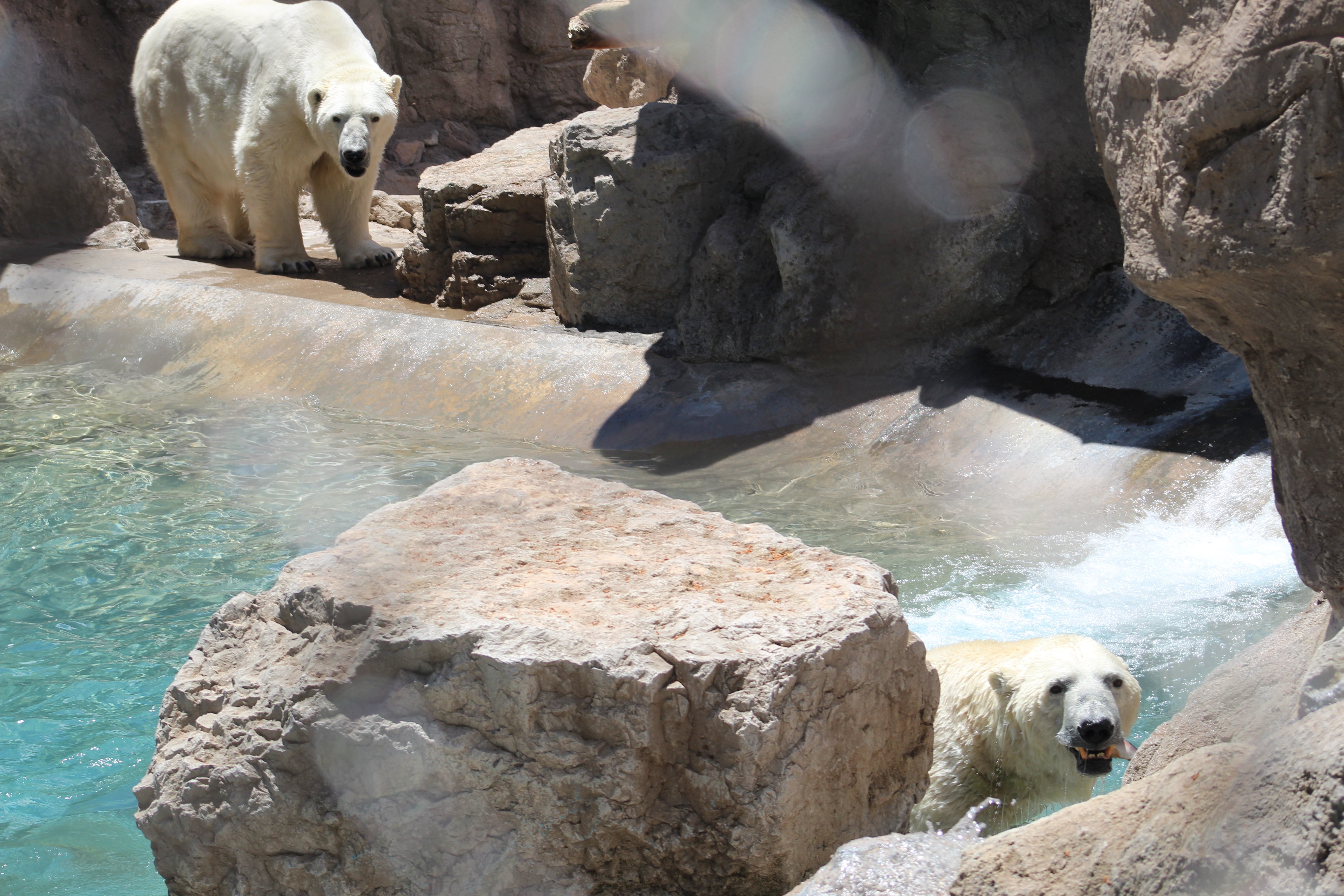
Chinook on the left, and Kalluk


The famous trio of the San Diego zoo has lost the magnificent Kalluk, who died at the age of 24, due to diseases of old age.

Stare down with Kalluk

 The world famous San Diego Zoo's polar bear habitat, Polar Bear Plunge, sits atop a hill far from the entrance, and for over two decades, Kalluk has been the king of that hill, with his companions sister Tatqiq and mate Chinook. The famous ornate California Tower of Balboa Park loomed in the distance as visitors could watch the polar bears frolic.


Kalluk under the California Tower in San Diego's El Prado.


Chinook (hidden),  Kalluk in the middle, and sister Tatqiq.

 Kalluk's story started in the winter of 2000-01, when he and his sister were born in the wilds of Alaska. Their mother, even though she was wearing a satellite collar, was shot and killed by a hunter near Point Barrow, Alaska. The cubs were rescued within hours, and brought to the San Diego Zoo at the end of March 2001. When Kalluk and Tatqiq arrived in San Diego, there were five other bears there, including Chinook, who was born in the wilds of Manitoba during the winter of 1995. As a young cub, Chinook had become separated from her mother, was rescued and brought to the San Diego Zoo. Neil and Buzz were there too, but in just a couple of months, moved to their permanent home in Como Zoo, St. Paul Minnesota.


The three bears love to have play fights in the water.
When the cubs arrived at the San Diego Zoo, the little male was 12 pounds and the little girl was 10. To tell them apart, the keepers shaved a spot on Kalluk's head. They called them Bubba and Sissy at the start.

Kalluk attacks during one of their fun battles.
In 1996, when Polar Bear Plunge at the San Diego Zoo first opened, there were more polar bears in American zoos than there were accommodations, so the enclosure was built without plans for these bears having cubs. The San Diego Zoo remodeled Polar Bear Plunge in 2010 to provide mother-cub accommodations, but there were no cubs born.

Epic battle
Officials made the decision to keep brother and sister Kalluk and Tatqiq together, since they had developed a very strong bond. For a time, Tatqiq has had birth control implanted during her annual physical exam, although zoo staff said Kalluk only had eyes for Chinook during breeding season.

Kalluk and his sister Tatqiq

Kalluk was about 1100 pounds at his peak. The keepers always gave the bears lots of vegetables, especially carrots, to keep their weight down in this warmer climate of San Diego, although it doesn't get terribly hot there, with the ocean breezes.

Three way battle. Everyone wins.

Kalluk liked to lie half in the dirt, so the other half was clean. He favored taking his naps in the center rock shelter by the double doors in the back, at the plunge point on the beach, and sometimes in the sand box in the middle.

Kalluk wakes Chinook from her nap, on the big rock

The zoo tour bus stops at the polar bears
 so everyone can get a good look.

The three bears got along very well, and I witnessed some incredible play battles in the big pool. They have always had a lot of fun together. Often Kalluk would be swimming, and the girls would be off together.


Taking turns attacking.
Tatqiq and Kalluk were incredibly bonded, and she will miss her lifelong playmate. Chinook will miss him too. Farewell, handsome Kalluk. You were loved by so many.

San Diego's golden couple, Chinook and Kalluk


Kalluk and Chinook

Wednesday, March 12, 2025

Haley moves to Detroit Zoo


Haley in 2012 in Memphis

22 year old Haley has made the move from the Memphis Zoo, where she lived with Koda, to the Detroit Zoo, where she will live with Crystal's daughter Suka, and Koda's twin brother Nuka, in hopes that she will finally have cubs.

Haley in Memphis, 2012.
Haley was born November 15, 2002, in Seneca Park Zoo in Rochester NY. Her parents were Aurora, born in Salt Lake City to Cheechacko and Chinook, and Yukon, who was born to Connie/Amy and Icee in the Cincinnati Zoo. 

Haley in Memphis

Haley is sister to Anoki, born in 1996 and now in the Seneca Park Zoo, and to twins Lee and Anana, born in 1999. Lee is now in the Columbus Zoo, and is the father of Kulu, with Crystal's daughter Aurora; Kulu is now in the Como Zoo in St. Paul. Anana is in the North Carolina Zoo. Like her sisters, she has never had cubs.

Haley had lived with Marty's brother Payton in the Memphis Zoo for many years, but there was an incident early on where Payton was chasing Haley up and down the steep rocky habitat. She fell and broke her leg, and after a period of healing, the keepers continued to limit contact between the two bears, for fear of a repeat.

Payton was moved to North Carolina, where he became companion to Haley's sister Anana (Lee's twin), but no cubs ever came of this pairing.

Haley's mother Aurora was sister to the famous Denali, father of 8 cubs in Japan). She was also half sister to Anana (a different Anana, who comes up later in our story), the late Koluk and his twin brother Kiska, who lives in Albuquerque.


Nuka in Detroit


Twin brothers Nuka and Koda were born November 25, 2004 in Denver to mother Voda and father Kavek. Nuka and Koda's older sister Cranbearry was born in 2001, and now lives in the Alaska Zoo. Kavek was brother of Rizzo of the Cincinnati and Hogle Zoos.


Koda and Nuka moved to Pittsburgh in 2006. Koda lived most of his life in Pittsburgh, where his sometimes companion was his Aunt Snowflake.  Koda moved to Memphis in 2021. Nuka moved to Detroit in 2011, where his mate was Talini. No cubs happened, so Talini moved to Chicago LP, and Crystal's young daughter Suka came to Detroit. 

Nuka on the Tundra side, Suka and Astra on the meadow side.

In Detroit, Suka had several pregnancies where the cubs did not survive. Then in 2020, she gave birth to Astra and Laerke. Astra was strong, but newborn Laerke was struggling, so after a few days, she was removed and raised by keepers. 

Twin sisters Astra and Laerke, separated during their first two years.

Astra was a strong healthy cub, but Laerke was small and struggled sometimes. The Detroit Zoo brought in a rescued grizzly cub from Alaska to help Laerke socialize and learn to be a bear. They made for an odd couple, but both cubs were happy with the arrangement. 

Jebbie and Laerke in a friendly bear hug.

Eventually Jebbie grew too large for the pair to safely continue. He found a good home at a bear sanctuary in Colorado.

The girls were reunited several years later, and moved to Tacoma Washington, where they continue to do well.


Nuka

Nuka's life as a soap opera

Although he is a bear, some of us polar bear fans have joked that Nuka's life has followed the plots of many human soap operas, from being the father of twins separated at birth, to being accused of murder and then exonerated, to having families with both mother and daughter, and now, stealing his twin brother's mate. Okay, that's enough anthropomorphizing!

The real story

After Suka gave birth to the twin girls Astra and Laerke, who were separated shortly after birth, a lady bear named Anana moved to Detroit from the Cincinnati Zoo, and there were hopes of a successful breeding. What followed was a tragedy, followed by unfair accusations and rumors.

Sadly, Anana was found dead on the Tundra area one wintry morning, and initial suspicions suggested that Nuka was responsible, in breeding gone wrong. There were some bloody wounds on her head. This was a shocking thought, especially since Nuka had always been a very gentle bear and the two bears got along well. Months later, the necropsy showed that Anana had died of natural causes, heart failure. The superficial wounds on her head were caused by Nuka trying to wake her up, to get her to move, alas in vain. The true cause of death was not publicized except in an email necropsy report to Zoo members (which I had access to), so many people went on to blame Nuka for years. 

As the soap opera continued, the Toledo Zoo, only an hour's drive away from Detroit, had lost Marty, the father of all of Crystal's cubs, to old age. So Crystal, Suka's mother, was alone. As mother of seven, Crystal was thought to be still fertile, even though she was up in years. So Nuka was invited to come to Toledo to spend romantic time with -- yes, basically his mother-in-law -- while Suka raised Astra, and the keepers took care of Laerke in the neighboring city of Detroit.

There was worry from the Toledo Zoo fans and maybe even the staff, about Nuka and the safety of Crystal, given the false story about Anana. This blog seemed to be the only news source in the world with the correct story, so the Toledo Blade newspaper contacted me, and printed the true story exonerating Nuka, the two bears were introduced, and all was well.

Nuka and Crystal got along well, and that fall, twins Kallik and Kallu were born. Nuka returned to Suka in Detroit.

Birthday party for 2 year old Kallu and Kallik and 26 year old Crystal

The Detroit Zoo was hoping that Suka and Nuka would have cubs this past fall, but there was noisy construction nearby, and maybe that disturbed the natural cycle. In any case, there were no cubs born in a US zoo last year, or the year before.

This is why Haley was moved to Detroit. All of the polar bears  in the US under the age of 10 are offspring or grandchildren of Crystal, except for rescued youngster Kava in the Alaska Zoo. In fact the last cub born in the US that wasn't a direct descendent of Crystal was Anana's daughter Luna born in 2012, the same Anana who tragically died in Detroit. 

Aurora and Yukon of Seneca Park were parents of four cubs, but only one has become a parent: Lee, father of Kulu in the Columbus Zoo. And now there is new hope that the next generation will continue with Haley's latest move to Detroit.

It is rather late in the breeding season for the two bears to be introduced, but I am sure the keepers will do what they can. 22 years of age is quite old for a first time birth for a polar bear, but fingers are crossed. 

The only living male polar bears who have fathered cubs in the US are Nuka and Haley's brother Lee. Next spring we may see cubs in Detroit, Columbus, and maybe even in Toledo, where wildborn Kali has just arrived for Crystal's approval. 

Sunday, June 4, 2023

Polar bears Kiska and Koluk in the desert

Kiska in front, Koluk sleeping in back.
 I took these photos about two weeks before Koluk died.

Some people may wonder how polar bears do in a desert environment as in the ABQ Biopark in Albuquerque NM. Twin brothers Kiska and Koluk  have lived there for a quarter of a century in good spirits most of the time. 

Koluk standing atop the basin, Kiska in front.

 Sad to say, Koluk died of liver and kidney failure, common illnesses in polar bears of advanced age, a little more than a week after my visit. He was 26 years old. His twin brother Kiska carries on by himself now, and seems to be in robust health. 

I visited the brothers last summer, and they were both active and playful. This visit, Kiska was his old self, but Koluk was barely there, coming out rarely, never swimming, very slow of movements. I could tell he was not doing well. His twin brother Kiska knew this as well, I am sure, and left his ailing brother alone.

Kiska and Koluk having breakfast together in the cave area.
It seemed to me that Kiska had already moved on, that he knew his brother was dying and it was best to just let him be alone. The boys usually nibbled on their breakfast together down in the cave area, the Koluk went inside while Kiska roamed around the enclosure, doing his own thing. Kiska carried on with the business of being a polar bear, swimming and playing and pacing and sleeping. 

Koluk would occasionally come out into the lower area, and a few times he climbed to the upper area, then dozed on his favorite rock, while Kiska roam and played.

On my last day there of my four days at the zoo, I finally found a polar bear keeper and conveyed my worries about Koluk. Yes, he was slowing down, I was told, but I was assured he should be fine again. By the end of the week, the vets had done an exam of Koluk and found liver and kidney failure. It progressed rapidly and he was gone a week later.


Kiska front, Koluk back

Koluk resting his chin on a rock.

And now it is just Kiska.

Kiska killing the barrel.

If you look hard enough, over by the wolves, you can find the old small outmoded polar bear enclosure which was been abandoned when the new habitat was built a quarter of a century ago, but is still there behind a fence. The newer enclosure was finished just before Kiska and Koluk arrived in 1997. The bears have three waterfalls, a lower pool and a deep diving pool, a slide with running water (which they have been known to climb up), and air conditioned bedrooms. There is also an inside pool.

To address Kiska's pacing problem, some changes were made recently. Kiska had gotten into the habit of pacing atop the rim of the upper pool, repeating the same seven steps in one direction, then reversing and doing seven steps back. Always in the same spot. Some polar bears pace, some swim laps repetitively. It is a calming mechanism, and has been shown to lower their cortisol levels.

Kiska in his pacing routine, which is now less frequent than it was.

A plan was devised to give the polar bear brothers access to more inside space which had previously been closed off to them, and when Kiska has been pacing for a bit, a keeper will call him inside to disrupt the pattern. When he returns to the outside, Kiska usually finds something else to do. These measures have reduced his pacing considerably, but he will probably always want to do his little dance. He  sometimes will stop pacing on his own to take a dip in the pool, or play with the many toys. 

Treat time, which is when the keeper brings in a bucket of rainbow trout to throw, will vary so Kiska won't be as likely to anticipate it. Anything to break up the usual routine. Sometimes they get salmon, but their favorite is squid.

Koluk with his fish. Although he was always an avid swimmer, Koluk wanted the fish thrown to him on dry land so he didn't have to get his paws wet, during his illness in his last few weeks.

Koluk was diagnosed with a heart murmur in 2019 and after that, the keepers made sure Koluk got his fish without diving for it. In his last few weeks, Koluk didn't want to put his paws in the water, even to get fish. 

Kiska is still quite the diver.


Kiska dives for the trout.

The zoo is in the middle of some major building projects right now, the Australian area and the new elephant habitat, but there is also a tentative plan down the road to improve the polar bear enclosure. 

Since the lions Kenya and Dixie left for Abilene in March of 2023, that grassy habitat adjoining the polar bear home has been empty. It was too small for lions, but it would be quite easy to attach it to Inukshuk Bay, which is what the polar bear area is called. I don't know if the death of Koluk will affect this, or how solid is this plan.

Welcome to Inukshuk Bay.
Connecting to the old lion enclosure would greatly improve the polar bear habitat, giving the bear (or bears) more variety, a much bigger area, and grass. From talking to the docents, I got the idea that when both these bears are gone, the zoo plans to stop keeping polar bears, but this clever change might bring it up to current standards.

The old lion habitat is fronted by a moat.

Edge of polar bear habit (left) adjoins the old lion habitat.

The edge of the old lion habit, empty now.
 You can see the walls of the polar bear habitat behind.

 Of course with the death of Koluk, we now have only 39 polar bears in US zoos, so it is not a sure bet that polar bears will be available. On the bright side, Crystal and Nuka's twin boys in Toledo were added to the population, and they are only six months old.

Kiska having fun with a big barrel.

Kiska is pretty playful for a 26 year old bear.

I did see Kiska playing with a big barrel for a long time. Even though he is 26, he is very playful. 

Kiska doesn't swim for long periods,
but he often takes quick dips in the chilled deep dive pool.
There is a lovely huge underwater viewing window.

He also likes to take short swims in the deep dive pool, which gives visitors a chance to see a polar bear underwater up close.


Kiska in the swim. 


A wider view of the polar bear enclosure, with a lower pool and an upper deep dive pool, a waterslide, and three waterfalls.
That is Koluk on the top.

Kiska and Koluk were born in Salt Lake City in November of 1996 to Chinook and Andy. Their half brother Denali lives in Sapporo, Japan and is the father of eight cubs. Anana (mother of Buffalo Luna) of Brookfield, Cincinnati, Buffalo and Detroit was also their younger sister, and they had a half sister, Aurora of Rochester, mother of Lee (father of Kulu), Haley, Peyton and Anoki.  

And here are their cousins around the world! Their grandfather was Bruno of Memphis, who was also the father of CW and Elvis who went to Europe. Elvis was the father of the famous Chocolate Bears, or Hybrid bears, Tips and Taps. CW was the mother of Nuuk-Nordman, father of Freedom; Ilka, mother of Danish Siku, Nanu and Nuno; Manasse, father of Ranzo and Sisu; Baffin of Japan (mother of Momo-Peach), and the late Yukihime of Japan. So their cousins include Ranzo of Vienna Austria, Sisu of YWP in the UK, Kulu of Como Zoo Minnesota, Sprinter of Hanover Germany, Sesi of Mulhouse France, Taiko-Siku of La Fleche in France, Akiak of Amneville France, cubs Kaja and Skadi of Rostock Germany, and Sura of Ouwehands the Netherlands. Not to mention all of Denali's cubs and grandchildren in Japan. 

I will be watching to see what the future holds for the polar bears in the ABQ Biopark. Kiska seems to be in good health, and may live for quite some time. Maybe the expansion plan involving the lion habitat will happen. Even though some may think the desert is not a good home for these bears, Kiska and Koluk have thrived here for 25 years. I hope Kiska continues to be well and enjoy his desert paradise.

Saturday, May 27, 2023

The last days of Koluk


Koluk two weeks ago

When visitors enter ABQ Biopark in Albuquerque, New Mexico, the first thing they see is a huge marquee photo of polar bear brothers Kiska and Koluk above the entrance gate.

Above the ticket taking booths at ABQ Zoo, the polar bears greet you.
Now news has come that one of those gorgeous bears, Koluk, has passed away.

When I visited ABQ Biopark in Albuquerque two weeks ago, I couldn't guess that one of the twin brother bears I had come to see would be gone so soon.

I had planned to wrote a piece on my visit to the bear brothers in the desert, and I still will do that, but sadly, I must write a farewell to Koluk, the most handsome of polar bears. 

Kiska is front, Koluk in back

Koluk and Kiska were born in Salt Lake City in November of 1996, so they were both getting up there in years, but both of them looked pretty hefty and healthy for male bears of 26 years. However, I could tell that something was up with Koluk, for his fur, usually green with algae from all his swimming, was white. He hadn't been in the water for quite awhile. His movements were slower. He kept to himself. He was just not his fun-loving self.


Koluk's fur was white, not its usual algae green.

 Koluk spent much more time behind the scenes than his twin brother. While Kiska was out and about and having fun, Koluk had hidden himself away much of the time. Even when the keeper threw the special daily treat of Rainbow Trout into the water, Koluk didn't want to wade in to retrieve it. But wade in he did, with a complaining look, and got the fish.


Koluk did wade in a bit to get the rainbow trout.

Koluk then retreated onto dry land to shake off and eat his prize.

Koluk, always the swimmer, would rather remain on shore during his final weeks. Kiska still dives right in.

I spent four days at the zoo, and on Monday, May 15, I waved goodbye to the the polar bear brothers, wondering if this would be the last time I would see Koluk, for I suspected he wasn't well.

The brothers on Mother's Day, under a brilliant sky. Koluk on the left.

I told the keeper, whom I had met last year, that I was worried about Koluk. He had slowed down so much, was staying out of sight mostly, and hadn't been in the water at all, which was not like him. She said that Koluk had shown some behavior changes for the past couple of weeks, but the changes were pretty recent and hopefully he should  get back to normal and be fine. 

Koluk


But on Friday, May 19, Koluk underwent an examination while under anesthesia, and the vets found that he had advanced liver and kidney failure. During the next week, they did what they could, but his health declined faster than expected, and he was released from this life on Friday, May 26.

He and his twin brother came from the Hogle Zoo in Salt Lake City to Albuquerque when they were just ten months old, so they have lived in the zoo in the desert for a quarter of a century.

Their mother was Chinook, descended from Bruno and Hilda of the Memphis Zoo, and as such they are related to a good number of European bears descended from CW, daughter of Bruno, her daughter Ilka, and Freedom, her granddaughter. Kiska and Koluk's father was Andy, descended from Becky and Herman Jr. of the Buffalo Zoo. 

 The ABQ Biopark Zoo (then the Rio Grande Zoo) enclosure was new when they came, has a lower pool and upper pool, as well as a waterfall and slide, which the bears would sometimes climb up.


Koluk in the water, as was his usual habit, last summer.

The brothers swimming together in June of 2022.


In their early days in ABQ, their young niece Anoki, daughter of their sister Aurora, came to live with them for awhile too. She is now living in Rochester NY, where she was born.

Koluk in the water, Kiska on shore, in June of 2022.


Koluk and Kiska were brothers of the late Anana of Buffalo, Brookfield, Cincinnati and Detroit, and half brothers of the late Aurora, and also Denali who lives in Japan and is father of eight cubs there. They were uncles of Luna of the Buffalo Zoo (daughter of Anana), and also Lee, Anoki, Peyton and Haley, children of Aurora.

Koluk was a handsome bear, with a magnificent head. He was chosen by Joel Sartore for his photographic Animal Ark, featured in National Geographic. 

He was playful all his life, and even sometimes threw balls and other toys over the fence to the visitors.

Koluk playing with balls, last summer.
 He was always one to have fun with his toys.


In 2019 he was diagnosed with a heart murmur. After that, when it was fish throwing time, the keepers would invite Kiska to do his cliff dive, but Koluk was restricted to getting his fish at ground level.


The last photo I took of Koluk (in back) on May 15. Eleven days later he was gone. Right after the fish throw, Koluk retreated into the bedroom area, all worn out. That's Kiska in front, ready for more adventures.


Kiska and Koluk are much like that other pair of twin brothers, Neil and Buzz in Como Zoo in St. Paul Minnesota, about a year older than Kiska and Koluk, together all their lives. When Buzz died a few years ago, Neil was alone, but before too long, an older lady bear named Nan moved in, and then three year old Kulu came along, and Neil was not alone any longer. Maybe a companion can be found for Kiska. If not, Kiska will be just fine on his own.

During my four days at the zoo, I noticed that Kiska had, in a sense, already moved on and was behaving independently. He did take note of his brother, and they spent some time together, mostly in the front cave area in the morning, eating breakfast together, enjoying the polar bear chow spread out for them with extra fruits and vegetables.  But Kiska spent his days in fun activities, tossing and destroying a barrel, swimming in the deep pool, doing his seven step pacing dance on the ledge (although not as much as he used to). Koluk sometimes came out to watch, but mostly stayed inside.

The polar bear brothers have been a big part of the ABQ Biopark Zoo for a quarter century, and Koluk will surely be missed by his many fans and friends, and especially by his keepers, who loved him dearly. 

Rest in Peace, big guy.