 |
| Flocke and her first cub Hope, who was born November 26, 2014. |
It made worldwide news. Flocke had given birth to triplets, and four months later, they are still doing great!
 |
| Flocke and her newborn cubs, photo courtesy of Marineland |
All in all, the end of 2019 was an amazing polar bear birthing season, with a dozen cubs born in Europe, and several in Russia. Even the U.S.A had a cub (in Columbus again, of course). The remarkable story, however, was Flocke and Raspi's little family. Everyone would want to come to the French Riviera to meet them.
Cruel fate, in the shape of a worldwide pandemic, has intervened, and Marineland is closed through at least the end of June. I was to have visited during the first week of May, taking lots of photos of this little family, followed by another trip to see the rest of the cubs. Instead, I must be satisfied to see photos and videos posted by Marineland, and hope for a visit maybe next spring?
One European cub did make her public debut before the lockdown. Fans could visit little Finja in Tiergarten Schoenbrunn in Vienna in late February.
Just recently a few of the other cubs could be met, although there are great restrictions in those zoos. Fans can visit Milana and Sprinter's daughter in Hannover, and the twins Anna and Elsa in Zoo am Meer in Bremerhaven are now receiving visitors along with their parents Valeska and Lloyd.
 |
| Flocke and her babies, photo by Marineland |
But Flocke and her triplets remain isolated from visitors, except for those who work in the park and for a recent photo op for the press, a very limited event.
 |
| Photo by Valery HACHE/AFP |
Triplets who survive are quite rare in zoo polar bears, although not all that rare in Flocke's family.
A triplet birth at the Louisville Zoo in late 1992 gave us Aquila, Aurora and Arcturus, but all three are gone now.
 |
| The Louisville Triplets, Aquila, Aurora and Arcturus. Photo courtesy of the Louisville Zoo |
 |
| Skeena with her triplets in 1993 in the Louisville Zoo. Photo courtesy of the Louisville Zoo |
Victor and Huggies had triplets (Ewa, Henk and Jelle) in Ouwehands in 2005, named for their keepers. Ewa is in Sweden with Flocke's daughter Hope and also Wilbar. Henk is in Nuenen in the Netherlands and has fathered two sets of twins. Jelle is in Quebec and has fathered two cubs.
Flocke's grandmother Simona had triplets in Moscow in 2011 (Wolodja, Zefirka and a sister who has died). Wolodja is again a new father this year in the Netherlands, and Zefirka in the Ukraine has had cubs too.
I have heard of a case a long time ago where a wild polar bear with quadruplets was seen in Russia. Even triplets in a zoo come along about once or maybe twice in a decade.
 |
| Huggies, mother of triplets Henk, Ewa and Jelle. I took this photo in 2017, more of a grandmother now. |
When Huggies' daughter Freedom gave birth to Akiak and Sura in 2014, they started out as triplets, but one of the cubs did not survive.
Malik of the Aalborg Zoo has given birth to four sets of triplets over the years, but there were early losses each time. Her first cubs were all three gone in just a few days. Her second set of triplets soon became just one cub: Augo.
On November 26, 2016, Malik again had three cubs, but only Qilak and Nuka lived. Her new set of twins, still with no names, started out as triplets, but one expired after a day. Aalborg Zoo has dencam, so we watch the drama playing out, with great disappointment but it isn't surprising since polar bear cubs have such a low survival rate, maybe only about fifty percent in zoos and in the wild.
I am sure there may be many other examples of triplets being born, but we often don't hear about those who only live a day or two.
Flocke's story
There were those who said that Flocke would never grow up to be a proper bear, having been raised by keepers. They said she wouldn't know what to do with a cub. How could she be a good polar bear mother when she was raised by humans?
 |
| Flocke in her ice cave with Hope in 2015 |
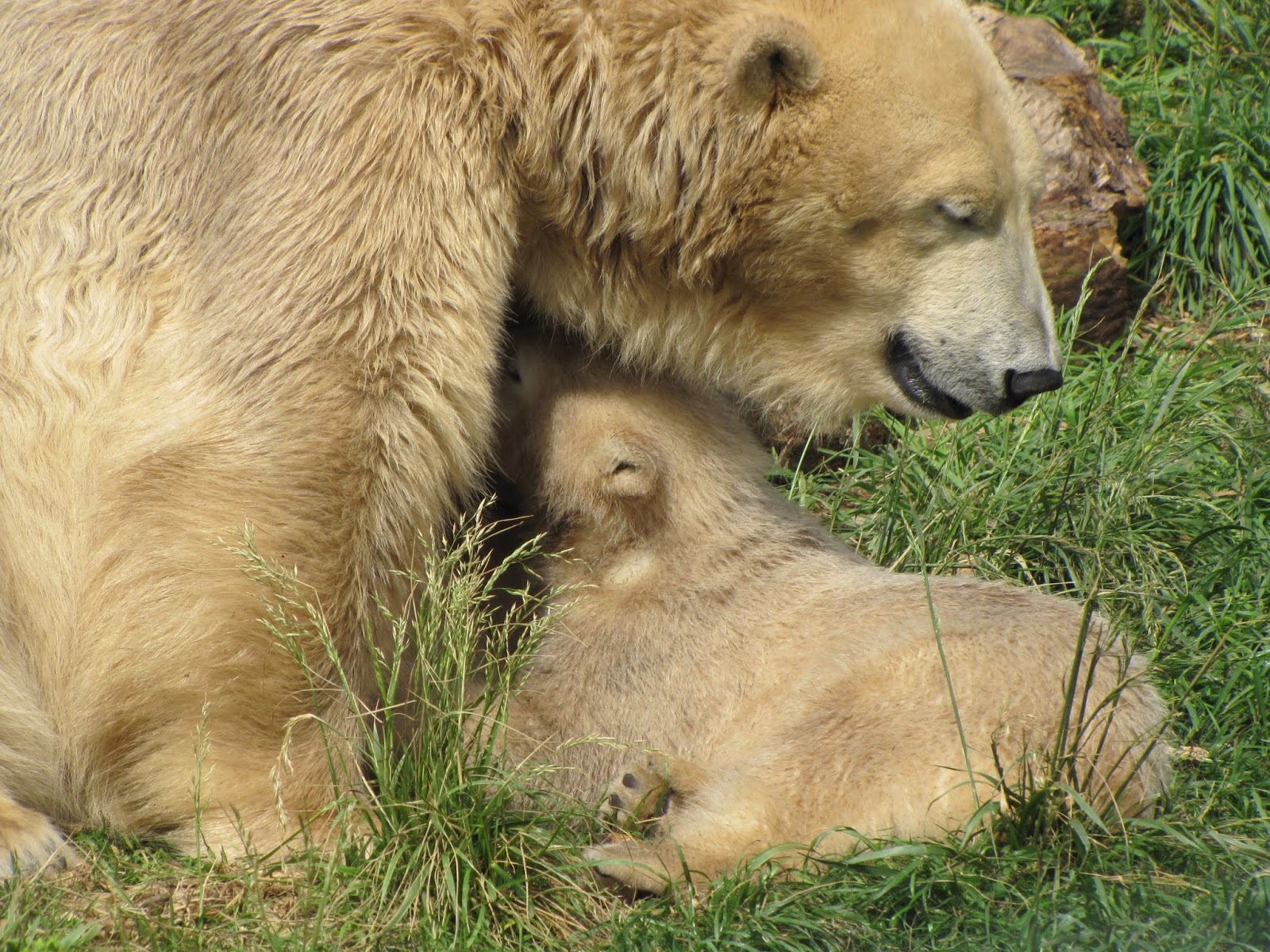 |
| Flocke nursing little Hope in 2015 |
 |
| Flocke and Raspi in Marineland |
Flocke was born in Nuremberg Germany to Vera and Felix in late 2007, and when her mother Vera, a very young mother at only 4 years old, kept dropping the cub, the zoo director to have keepers raise Flocke by hand.
Flocke needed a playmate, so when she was about a year old, a male cub of the same age arrived from Moscow. Flocke and Rasputin each had someone to play with. Right from the start, Flocke, although smaller, was the boss. The two cubs got along very well.
When Flocke and Raspi were a little over two years old, they moved to a brand new state of the art habitat at Marineland on the French Riviera, right on the Mediterranean with those lovely sea breezes. They had ice caves to keep cool, two large diving pools, and three spacious enclosures on two levels.
Flocke gave birth to Hope five years ago, and Raspi was separated from his beloved Flocke for three years, while Flocke took great care of their daughter. It was difficult for Raspi to be so near Flocke, and yet separated. He could interact with Flocke and Hope through peepholes between the two upper enclosures at water level in the pools, and sometimes through the bars between one of the upper enclosures and the lower mother-child area.
Hope, at the age of three, went to Sweden two years ago, and the two adult bears were reunited! Raspi was very happy, but they still had to be separated on occasion so that Flocke could have a break from being so passionately pursued.
All their romantic activity has resulted in triplets, just announced by Marineland. It was also announced that Raspi had moved.
Flocke gave birth to her triplets at the end of December, and now Raspi, or Rasputin, has gone to a polar bear bachelor camp in England, so Flocke can have peace and quiet to raise the children. Raspi will be distracted by his new surroundings and new friends, away from all female bears, so he won't get frustrated during spring breeding season.
At Yorkshire Wildlife Park, Raspi will be separated from the other bears for four months, living in a spacious area previously occupied by Japanese brown bears, who have since passed away. He has a grassy meadow and a lovely pond in which to swim. By all reports, Raspi has hit the ground running, and has settled in nicely, having a great time exploring his new estate. He looks happy.
The other polar bear occupants at YWP, a recently built zoo constructed on an old farm, are patriarch Victor, himself father of triplets and many other cubs: younger male bears Nissan from Russia, Nobby from Munich, and Victor's grandson Pixel from the Netherlands. Pixel is the son of one of Victor's triplets, Henk.
Project Polar, as the polar bear area is called, consists of three huge grassy meadows with ponds and caves and rolling hills. YWP plans to develop a fourth enclosure next to the central holding area. Raspi is in another spacious area for his quarantine.
Thus the male bears can be separated, or put together for good company as their moods dictate. By and large, Pixel and Nissan are best friends and usually together. Young Nobby makes do with the company of older bear Victor. Nobby would love to play with Pixel, but Nissan can be jealous. Thus it might be nice for Nobby to have a playmate in Raspi when quarantine is over.
In the meantime, back at Marineland, Flocke can have lots of space to raise her cubs.
There is talk about Marineland giving up polar bears in a few years, but with 12 cubs born this past season, and the superior conditions of the Marineland plant, Europe will need all the polar bear homes currently occupied, and more
I wonder if Flocke might come to YWP, and the three younger males at YWP be sent to other zoos, for there will be young females needing mates. The triplets could remain at Marineland for a few years.
 |
| Flocke and Raspi, together in happy days at Marineland |
I hope I get to visit Flocke's triplets before they are all grown up. Right now, the earliest I think it would be possible is next spring.
So for today, I wish a happy Mother's Day four generations of great polar bear mothers: to Flocke, to her mother Vera, to Vera's mom Simona, and to Simona's mother in St. Petersburg Russia, Uslada.
Happy Mother's Day to the new polar bear mothers taking care of new cubs this year in Europe and the USA: Aurora in Columbus Ohio; Flocke in Antibes France; Milana in Hannover Germany; Valeska in Bremerhaven Germany; Freedom in Ouwehands Zoo the Netherlands; Malik in Aalborg Denmark; Noel in Copenhagen; and Nora in Vienna.
And a Happy Mother's Day to all the polar bear mothers who have ever raised a cub. It can't be easy taking care of those active hungry adorable little cubbies.


