Showing posts with label Polar Bear Cub. Show all posts

Tuesday, January 7, 2025

Qannik's birthday with a love match theme


Little rescued polar bear cub Qannik, now all of 14 years old, is ready to throw her ring into the dating pool. Actually, the love match has already been made, and Qannik's beau Bo, age 6 years, was just across the way during her big birthday party on Saturday, January 4, at the Louisville Zoo. He has been courting her for the past year, since his arrival from Henry Vilas Zoo in Madison Wisconsin. Having lived alone for all of her 14 years, Qannik has been a reluctant girlfriend. On the other hand, Bo has never lived alone until he came to Louisville, having lived with his mother Crystal in the Toledo Zoo, and then with older lady Berit in Madison.

Young Bo (left) and Berit in Henry Vilas

While they have spent quality time at the "howdy gate" getting to know each other during the past 11 months, Qannik and Bo have not yet been put together in the same space without a barrier. That is about to change.

Bo in the indoor exhibit at Louisville on Saturday
Qannik's specimens have been sent to CREW at the Cincinnati Zoo on a regular basis during the past year, and her hormones spikes have been charted. According to her charts, the ideal time for Qannik to meet Bo and be receptive is in the next couple of weeks. 

The keepers plan to introduce the two sweethearts in the large outdoor enclosure some morning before the zoo opens, with a large staff present and plenty of preparation. There will be fire hoses at the ready, as well as a number of other precautions to separate them if needed.  After all, Bo does weigh twice as much as Qannik. But hopefully, all will go well, and Qannik will welcome Bo's attentions. He has been anxious to spend time with her for the past year. Keepers say that Qannik's attitude towards Bo has warmed up considerably, and she is interested.

Bo in the overhead bridge

With Qannik's social life about to change, the keepers thought a dating app theme would be appropriate for Saturday's party, held with just a small public crowd on a very cold day.

Bo's dating app page. He weighs 1045 pounds, and likes barrels,
 long walks by the pool, and fine dining.


Qannik's dating app page. She weighs 485 pounds, and likes grapes, snuggling and chewing on bones.

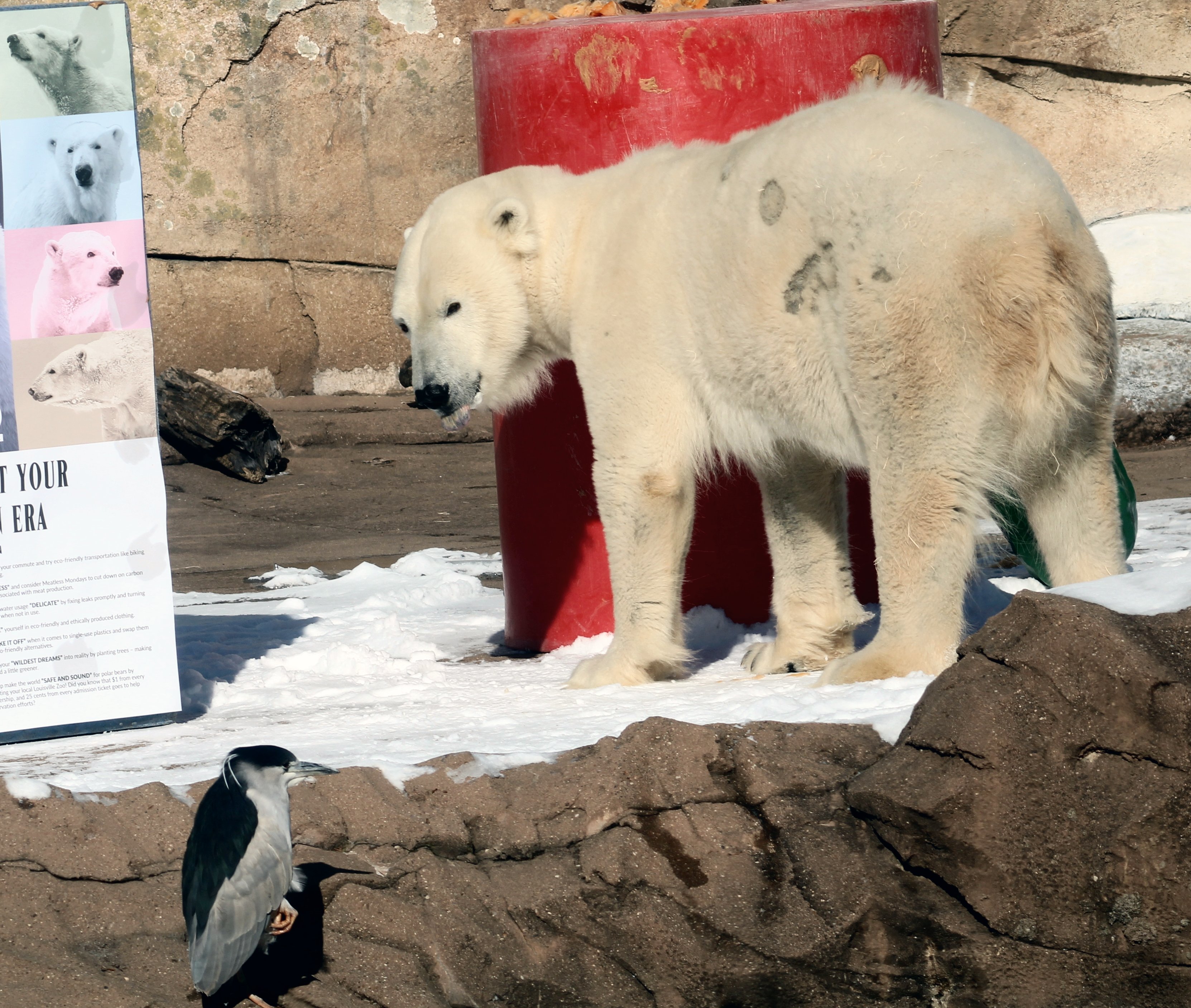
 Everyone sang Happy Birthday, while Qannik came out to find a nice meaty knuckle to chew on, a brand new giant pickle, lots of peanut butter smeared on birthday blocks, a Christmas tree, and her favorite, a frozen pumpkin.


Qannik swipes right


Qannik finds the peanut butter.

A new pickle. The keepers say they will have to keep it way from the boys, polar bear Bo and grizzly Otis, who are rough on pickles.


A frozen pumpkin is a favorite treat.
 The keepers have about a hundred put away in a freezer for her.


Qannik settles down to consume her birthday treat.


Since Bo already had a big breakfast and wasn't invited to the party,
he took a nap.

Since Qannik is property of the Fish and Wildlife Department as a rescued bear cub from Alaska, Louisville Zoo had to get special permission for her to be part of the breeding program. As a wildborn bear, Qannik's genes are especially valuable. This match is important because almost all the younger polar bears in US zoos are related to Crystal, and Qannik is not related. 

Bo, the son of Crystal and the late Marty at the Toledo Zoo, came from Henry Vilas last February, and has been waiting for Qannik to come around to him ever since. Let's hope it all works out for the "love match" at the Louisville Zoo. Valentine's Day is just around the corner. Maybe Qannik and Bo will be the next supercouple.


Here's a flashback to Qannik's fifth birthday party, in 2016, where she had a peanut butter cake from a bakery.


Wednesday, July 31, 2024

Qannik and the dating game

Qannik paces in Polar Bear Alley in the Louisville Zoo last week.

 It has been an eventful year for Qannik, the young lady polar bear in the Louisville Zoo. She became an eligible bachelorette recently when she was  okayed for breeding by the Department of Fish and Wildlife, who owns her because she was a wildborn cub rescued in Alaska.


Here's Qannik celebrating her 13th Birthday with a Taylor Swift theme.

She celebrated her 13th birthday in January. Then in the middle of February, Borealis, a five year old prospective suitor, arrived from Henry Vilas Zoo in Madison Wisconsin.

I talked to one of the keepers last week about how things are going between the two potential lovebirds. The keepers gradually introduced the bears and have tried to put them together, but Qannik isn't ready yet. The bears are still separate, but Bo is always aware of where Qannik is. 

Young Bo, in Henry Vilas Zoo

Borealis, usually called Bo, was born in the Toledo Zoo, the son of Crystal and the late Marty. He was a single cub, so had the full attention of his mother, who dutifully played with him until he left Toledo for Wisconsin.

Baby Bo and Mom Crystal in the Toledo Zoo in 2019.


Bo being attentive to older lady Berit at Henry Vilas

At Henry Vilas Zoo, Bo was introduced to a senior citizen lady bear named Berit, who became his new playmate. Bo hated being separated from Berit, and would cry and cry. It is a good thing that mostly they were together. 

So Bo has never known what it is like to be solo. 

Qannik in Louisville at age 8 months.

On the other hand, Miss Qannik has been a single lady since she arrived in Louisville as a lost cub. She was raised by keepers, and relates to humans very well. She has always been aware of other bears, sharing the downstairs area with a grizzly family, and at times with other polar bears, just across the way so she could see them, smell them and hear them, but never had to interact with the other bears.

Siku in Louisville. Siku is older brother to Bo.

When Qannik first arrived in Louisville in the summer of 2011, older lady polar bear Arki was there, and also Arki's young grandson Siku, who was just a bit older than Qannik. As Siku grew into his male hormones, he was anxious to be near Qannik. But mingling was forbidden, as wild bear Qannik was property of Fish and Wildlife, and was not allowed to be part of the breeding program. 

Arki in Louisville. Both Siku and Bo are her grandsons.

Arki died of old age in 2013. Siku left for Chicago in 2016, and then it was just Qannik and the grizzly family in Louisville. The mother grizzly and her two cubs were rotated in the two public enclosures, along with Qannik.

The mother grizzly and her daughter were moved to another zoo, so then it was just Otis the  male grizzly left as a neighbor in Glacier Run. 

Otis and Rita, two of the three grizzlies at the Louisville Zoo.
Qannik's neighbors.
In 2020, the Columbus Zoo sent new father Lee to the Louisville Zoo, to make room for his son young Kulu. Lee remained in Louisville for about two years, but never was introduced to Qannik, who was still restricted as to breeding, which was probably very frustrating for Lee, to be so close to a young female but unable to do anything about it. However, Qannik was indifferent to his presence. And then he was gone,  returning to Columbus.

Qannik has always been aware of her star quality, and spends time at the window of the big pool area visiting her fans.
 She is especially fond of little girls wearing pink.


So for all of her 13 years, Qannik had been neighbors with various other bears, but lived as a solitary bear. And she has been perfectly happy that way. She has always been attracted to the youngest human visitors, sitting at her favorite window, posing for pictures, and playing with them through the glass.

Qannik with a young visitor.

 Last winter, things changed, and Fish and Wildlife finally relented and gave permission for Qannik to be paired with a male bear for breeding.

Bo
Borealis, born in Toledo to Crystal and Marty, was chosen as Qannik's potential mate, probably because he is young and used to playing second fiddle to an older lady bear. 

Young Bo arrived in Louisville in February, but had to wait through the mandatory 30 day quarantine, and by the time he could slowly be introduced to Qannik, the breeding season was almost over. Bo was quite eager, but Qannik was not so sure, so the window of opportunity passed. 

Qannik at the top of the stairs.

The keepers are not pressing the issue. Qannik and Bo remain separated. Although the two bears don't share the same space, Qannik and Bo have many opportunities to get acquainted at a mesh gate, where they can sniff each other, and rub noses if they wish. Bo is trying to impress Qannik, and she, while not entirely cooperative, often shows curiosity about Bo, goes over to the gate and sniffs at him, then walks away. They also see each other in the downstairs bedroom area, across the way.

Qannik's genes are unique in the US zoo polar bear population. Bo is related to many bears, but Qannik, rescued as an orphan cub, is related to no one. 


Currently, Qannik weighs about 500 pounds, while Bo weighs 950 pounds.

Things will change in a few months when the bears' hormones start to run high during breeding season, and the keepers are hopeful that Qannik, who has lived an isolated life until now, will start to see Bo as a romantic partner. Bo certainly hopes so. We should start to see a change in their relationship in January or February, and the bears may finally get together.

Qannik during the keeper talk last week. She enjoyed a bucketful of fish while one of the keepers told visitors Qannik's story,
 and answered questions.


Wednesday, March 20, 2024

This year's polar bear cubs -


Mother Frimas with Nivi and Elva, from my visit in 2019.

For the 2023-24 season, we have reports of only three cubs born and surviving this year, one in the Netherlands and twins in a remote northern area of Russia. 

Frimas and Wilbär are the parents of little Otis in Dierenrijk, a zoo between Mierlo, Eindhoven and Nuenen in the Netherlands.

Otis was born November 28, and his birth was announced on November 30. He just made his public debut a week ago. Otis is very popular, and already there are many photos of him with him mom, many of the photos showing how much Otis likes to get dirty. 

Baby Otis this week. (Photo by Hans Muskens)

Frimas, was wildborn in Canada in 2002 (estimated), and has been in Nuenen since 2011. She has already raised three sets of twins:  Pixel (m) and Noordje (f) born in 2012, Nicky (f) and Simona (f) born in 2015, and Nivi (m) and Elva (f) born in 2018. Henk, one of Huggies' triplets born in 2005, is the father of all three sets of triplets born to Frimas. He lives in France now.

Mother Frimas an Baby Otis. (Photo by Hans Muskens)

Otis' father Wilbär was born to Anton and Corinna in the Wilhelma Zoo in Stuttgart Germany in 2007, their only child. He moved to Orsa Predator Park in Sweden where he fathered daughter Miki born in 2020 with Ewa, and twin boys Noori and Nannok in 2021 with Hope. Sadly, Miki died of a heart condition at age 3 as she was being moved with her mother from Orsa to the UK. Hope, along with her twin boys, were also moved from Orsa to Peak Wildlife Park in the UK last fall, after Orsa Park closed.

Otis has some interesting great uncles and a great aunt. Antonia, the famous dwarf polar bear of Gelsenkirchen ZOOM, at age 34 is also the oldest polar bear that we know of. Antonia is the half sister of Wilbär's late father Anton. Both Anton and Antonia were born in Zoo Karlsruhe.

Wilbär's uncle Nanok II, who was half brother of Corinna, was also the father of Malik of Aalborg Zoo.

Corinna's older half brother Wilhelm, also called Willie, also born in Copenhagen, was sold to the East German Circus and ended up in a Mexican Circus, where he and five other polar bears were rescued in 2002 in Puerto Rico and taken to US zoos.  Their rescue was worldwide news. Wilhelm enjoyed a good life for ten years at the North Carolina Zoo and later the Milwaukee County Zoo. 

Father Wilbär, next door (Photo by Hans Muskens)

As the Russian twins, born in the Yakutsk Zoo (Orto-Doydu), the children of wildborn mother Kolymana, are quite remote, we haven't had much information on them. The Yakutsk zoo has announced that the twins will be allowed outside at the end of March. It is very near the Arctic Circle, so it is still quite wintry there. The gender of the cubs is not known. Father of the cubs is Lomonosov, son of Uslada. Kolymana and Lomonosov are parents of daughter Chaarchana (2016) and son Almaz (2019).

UPDATE on March 26: The cubs' birthdate has been announced as December 4. They are a boy and a girl, and there will be a naming contest.

“The cubs feel good, they run actively, tumble and play pranks, but they are always close to their mother. They have grown up and can confidently go out of the house in which they were born into the inner room. Kolymana also feels good, she has a lot of worries, every little bear needs an eye and an eye, but she’s doing great, she’s coping,” said Natalya Safonova, head of the scientific and educational department of the zoo.

The Yakutsk Zoo is about 450 miles south of the Arctic Circle, and quite remote, even from the city of Yakutsk.

In 2012, Kolymana was found as a wandering lost cub, all alone in the world, by members of the Bear Patrol in the ice of the East Siberian Sea in Nizhnekolymsky ulus. She was rescued and brought to Orto-Doydu,  the zoo which is just south of Yakutsk.  

Lomonosov, born in 2011, is the same age as Kolymana. He is the son of the late Uslada and Menshikov, who produced 16 offspring at the Moscow Zoo.

The Russian twins' birth was announced on January 29, but we don't know when they were actually born, and so far just an early den video, no photos. 

As the zoos in Russia and Europe are pretty much at capacity, there has been an intentional slowdown on breeding, and this is why there were so few cubs born last year and this year.

In the Fall of 2023, there were several births in Japan, but they did not survive. Also Friida in Tallinn Estonia had triplets, but just as in the previous two years, they did not live, and Friida is now thought to be too old and they will not try again. 

Last year

In 2022, Anouk was born in Hamburg, Germany, to Viktoria and Kap, the only cub in Europe. Twin girls Belka and Strelka were born in Novosibirsk Russia to Gerda and Kai, also in 2022. And in the USA, where there is plenty of room for more cubs, last year Crystal gave birth to twin boys Kallu and Kallik, with Nuka as the father. No cubs were born in the USA this year.

Thank you to my friend Hans Muskens for allowing me to use his photos of Otis and his parents in Dierenrijk.

Friday, September 16, 2022

A new chapter for Jebbie


Little Jebbie in October of 2021. Playing Pattycake.

Jebbie last week, September 2022

It was a beautiful friendship between the little polar bear cub Laerke and her rescued companion Jebbie, the grizzly cub. But all good things must come to an end, and Jebbie, now about 20 months old, has left the Detroit Zoo for a wildlife sanctuary near Denver, Colorado, where he will have space to run around and play and be his best self as he grows up. I hope there will be other young grizzly bears for him to play with there.


Jebbie on land, Laerke in the water, this is how they often played.

Little Jebbie, then only a few months old, had been found wandering in an Alaskan village in June of 2021, and brought to the Alaska Zoo, then to the Detroit Zoo to be a companion to Laerke, a polar bear cub being raised by hand. 


Cubs at play, October of last year


Laerke needed to learn the social skills important for a bear to know, skills that can only be learned by interacting with another bear. This pairing would also provide Jebbie with those important experiences too.


Laerke and Jebbie liked to spar. Play is how bears learn.
 (October of last year).

Laerke's twin sister Astra was being raised by their mother Suka, but Laerke had suffered life threatening medical issues in her first few days, and had to be removed from the den and bottle-fed. As Laerke grew, the Detroit Zoo sought a suitable playmate for her.  Jebbie seemed to be a good match, and he needed a place to thrive as well.

Laerke and Jebbie romping about the Tundra in October of last year

So by the end of summer, this little odd couple, the polar bear cub and the grizzly cub, were wrestling and running around the tundra area of the Detroit Zoo's Arctic Ring of Life. Occasionally, Laerke, as a polar bear cub and a marine animal, spent time in the pool, and Jebbie, a land oriented grizzly, would be on the shore. Most of the time, however, they were together, tumbling around, chasing each other, and doing what cubs enjoy.

Little Jebbie in October 2021


Jebbie last week

For six or seven months, these two taught each other important life lessons while they played. But Jebbie grew faster than Laerke, partly because he is a grizzly bear, but partly because Laerke lags behind in growth due to her early medical problems. The time had come to separate the two friends for safety reasons. Jebbie didn't realize how much stronger he was than Laerke.

The Detroit Zoo has been home to three orphaned grizzly bear brothers, Mike, Thor and Boo, since they were rescued in Alaska in 2011 after their mother was shot and killed illegally, but it was felt that Jebbie would not be welcomed into their bonded group, and he needed to find a home elsewhere.

Jebbie and the ball last week.


Jebbie tests the ball.


Jebbie thinks about going bowling.

Laerke now weighs 290 pounds, while Jebbie weighs 490 pounds, the same as Astra, Laerke's twin sister.


A silly face from Jebbie

For some months, Jebbie stayed in the same underground area near Laerke, and they would still see each other, but they were not allowed to be together in the outside habitat. About a month ago, Jebbie moved across the road to the small enclosure behind the primary grizzly habitat. There wasn't much room to run, but he got busy removing the few trees that remained. The keepers prepared him for the upcoming move by training him to go into the traveling crate and be comfortable there.

Last week, he took down the last tree, with great satisfaction. He was ready to make the trip to his new home in Colorado. 


Jebbie the morning after he took down the last tree, behind him.

Good luck, Jebbie. Grow up to be a beautiful grizzly bear in your new home in Colorado.

Decorated pumpkins at the Detroit Zoo in 2021 depict
 Jebbie and Laerke.


Sunday, April 17, 2022

The Three Bears of the Como Zoo

Kulu in front, Nan in the center, and Neil in the back,
having a lettuce snack.

Just like in the story of Goldilocks, there's a family of three bears living at the Como Zoo in St. Paul Minnesota. In this family, however, there are a Grandpa bear and a Grandma bear, living with a two year old cub, and they are all just right.

Kulu

Neil on the left, munching on lettuce. Nan is on the right.

26 year old Neil lost his twin brother and lifelong companion Buzz in August of 2020. 27 year old Nan arrived from the Brookfield Zoo the following February, so this pair has been together for over a year. Wildborn Nan lived for many years in the Toledo Zoo and is the mother of Nikita, who lives in the Hogle Zoo in Salt Lake City now, so she is familiar with the needs of a cub. 

Old lady Nan, on the left, watches as young Kulu passes by.
 She is a good babysitter.

Young Kulu arrived at the Como Zoo last October, just before his second birthday. He was born in the Columbus Zoo, the son of Aurora and Lee, on November 28, 2019.


Neil on the left engages in some friend horseplay with young Kulu.

The older bears at Como enjoy playing with this cub. Kulu is as big as they are but still thinks he's a baby. Neil especially likes to play fight with Kulu in the water.

Nan watches over Kulu playing in the water.

Nan is always keeping a watchful eye. 

Neil has experience playing with an older cub, from the time he and Buzz spent in the Detroit Zoo while Como Zoo was updating the polar bear enclosure. In Detroit, Neil and Buzz were playmates of young Talini, and they had a great time.

The Como Zoo has two wonderful outdoor areas for the bears, with an interior section as a pass through between areas and as access to the bedrooms. The visitor building is a nice cozy place to view the bears in the central area, as well as the two outside habitats.

I was lucky enough to visit Como for three days in early April, and it was cold and rainy, so the bear visitor building was the best place to be. Spring comes late to Minnesota. Only the right hand area was available to the bears during my visit. 


In the center training area, Kulu is standing up on the left,
Nan is center, Neil is on the right.

From left, Kulu, Nan and Neil, in the training area.

There were some fun interactions between the three bears in the central area. During past visits, this is where the keeper talks are given, along with training demonstrations. But not now, probably because of Covid.

Kulu had fun with the giant pickle.

Como Zoo is still requiring online reservations to limit the number of visitors. 

Kulu plays with a visitor.

We could observe Kulu swimming in the deep pool, and he had a good time with the many toys provided, as well as tussling with Neil. 

Neil (in front) and Kulu splash it up.


The two older bears, the "grandpa and grandma," get along well. Neil has adjusted to the loss of Buzz, and I am sure that having Nan and Kulu there is a big help, for Neil has always had a companion.


Nan is happy with her lettuce snack.

26 year old Neil (along with wildborn Blizzard of the Point Defiance Zoo in Tacoma Washington, whose birthday is uncertain) is the oldest male polar bear in the U.S.


Neil is looking rugged these days.

Nan and Neil in the training area.

At  27, Nan is up there in age too, and is the second oldest polar bear in the U.S., behind Berlin (32 years old) of the Kansas City Zoo.  Berlin, by the way, lived at Como Zoo with Neil and Buzz for a time after her enclosure in the Duluth Zoo was destroyed in a flash flood back in 2012. Neil is uncle to Berlin, even though he is younger.

Neil thinks about having some more lettuce.


Kulu has lots of toys.


Kulu is a very big cub. He was always big for his age.

So while the older bears like to play with Kulu, they do get tired and need to rest, so then Kulu is on his own. He is fine with playing by himself. 

I visited Kulu many times as he was growing up in the Columbus Zoo. I am happy to see how well he has settled into a comfortable routine at the Como Zoo.


The glass is wet from the rain, as Neil and Kulu battle it out.

Kulu seems very happy in St. Paul with his  adoptive "grandparents." 


Kulu with a sunken "iceberg"


Kulu

Kulu the champion swimmer

For visitors who would like a taste of spring, a visit to the Sunken Garden at to Como Zoo is a delight as well. 


Como Zoo is a free zoo, and also offers many botanical delights such as a rainforest room, a fern room, and the Sunken Garden.