Showing posts with label Arctic Ring of Life. Show all posts

Thursday, July 23, 2026

Kali has two girlfriends

Kali in Detroit

At almost 14 years of age, Kali is a lucky guy, with two girlfriends and living in the Detroit Zoo in one of the best polar bear habitats in the world. He spends his days napping, enjoying interesting snacks, wandering around the meadow in the tundra area, swimming through caves in the ice pack's saltwater pool, and watching his companions Suka and Haley swim and play nearby. 

Kali marches around the tundra area in Detroit Zoo 
He has gone through many years living alone up to this point, however. 


Kali looking rather solemn after being awoken from his nap

Kali profile


His story begins with a terrible tragedy. Kali was born in a snow den in the wilds of Alaska, near Point Lay on the Chuckchi Sea coast in the winter of 2012-13. His mother was larger than your normal female polar bear, so much so that a native Alaskan hunter mistook her for a male and shot her during a subsistence hunt. Upon examining the bear's body, the hunter realized that he had killed a nursing mother. The hunter knew there was at least one hungry cub out there, in desperate need of help and some good luck. The hunter followed the mother bear's tracks back to the den and found a tiny cub, tucked the baby into his coat, or maybe his backpack, giving him a ride to safety on his snowmobile. This was in March of 2013. 

Baby Kali in Buffalo

Kali's name comes from the native word for the village of Point Lay. 

Kali and Luna in Buffalo Zoo

Kali was turned over to the US Fish and Wildlife Service, and taken to the Alaska Zoo, where he was bottle fed and cared for. The Alaska Zoo had done this before, for Qannik, who now lives in the Louisville Zoo. 

Kali standing tall in Buffalo Zoo

In May, the cub was flown to the Buffalo Zoo in New York State, where young Luna was being raised by the keepers after her mother Anana neglected and ignored her. Luna was exactly the same age as Kali, and could use a playmate as well as helping Kali develop his bear skills. Both mother Anana and father Nanuq had moved to other zoos long before Kali arrived. 

Little Kali, next to the zebras.

I visited Luna and Kali in the summer of 2013, and found the two youngsters wrestling and playing up a storm. Because the Buffalo Zoo had just started construction of new polar bear habitats on the spot of the old bear grottos, the little bears were given a fenced in area next to one of the buildings, where they had constant supervision, a shallow pool, a semblance of a forest, shade, room to play and lots of toys. And of course they had each other. 


Luna and Kali
While Kali spent much of his time playing with Luna or on his own, he also had to get over the trauma of losing his mother. He comforted himself by sucking on his paws, and humming  loudly like he had a little motor running, as cubs do when they nurse. 


Kali and Luna at play. They had such good times.
The cubs were the star attraction of the zoo, with lots of folks wanting to get a glimpse of this cute little odd couple. 

Baby Kali
Everything seemed to be going well for these two cubs, until they were moved to the tiger enclosure. Luna fell into the moat and broke her leg, so the two cubs were separated while Luna's leg healed.

Kali at play
The playmates did have some time together once again, but soon Kali was sent off to the St. Louis Zoo, which had just opened up its fantastic new polar bear habitat Polar Bear Point, in May of 2015, and needed an occupant. 

Kali in St. Louis, 2016.
He settled into his new home in St. Louis just fine, and was a popular guy with all the zoo visitors, but he was all alone. The Department of Fish and Wildlife had rules that allowed rescued cubs to be housed and cared for in zoos, but they were not to be allowed in the breeding programs, so Kali was not to have a companion. 

Kali loved the kids in St. Louis. This photo was from 2016,
Kali is a very sociable bear, and loved interacting with all the visitors in St. Louis. His people-oriented personality probably comes from being fed and raised by humans in the Alaska Zoo and then the Buffalo Zoo. Kali is still beloved in St. Louis. 

Kali on his favorite ledge,
where he liked to sit and watch his fans in St. Louis


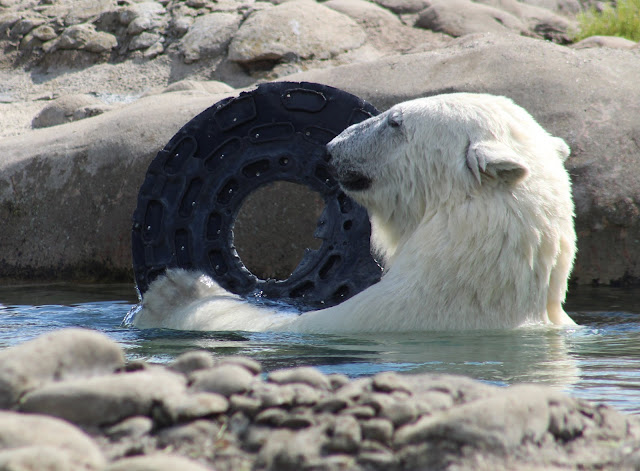
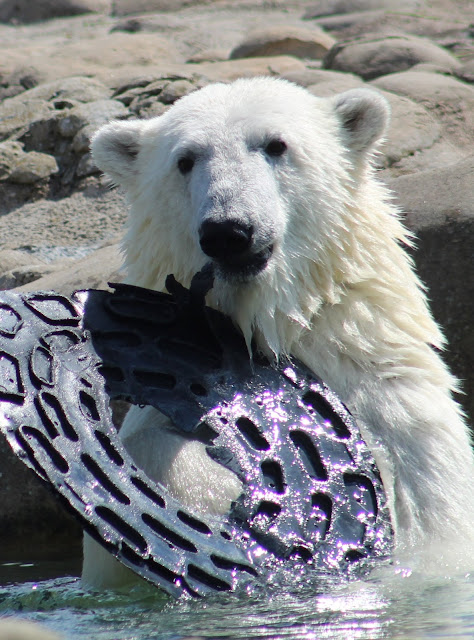
Kali with his tire in St. Louis. 


Kali in 2017 in St. Louis

Because of various political pressures, and the fact that polar bear breeding in the US zoos was in great need of fresh genes, the ban on rescued polar bears breeding was lifted several years ago. Kali, and Qannik too, could now be part of the breeding program.

In an exchange, the 2 year old twin boy cubs Kallik and Kallu from Toledo were sent to St. Louis in early 2025, and Kali was sent to Toledo, in hopes that he would be a breeding partner for the twins' mother Crystal, even though she is probably too old for such a venture and Kali was not prepared to deal with a female and inexperienced, having been alone for so long. 

Crystal and her twin sons, Kallik and Kallu
on their second birthday in Toledo. 

In Toledo, it was not a love match. Crystal actively avoided Kali, and Kali did not know how to deal with this mature polar bear lady. 

The queen mother, Crystal.
By the start of the next breeding season, it was arranged that Nuka, the father of Crystal's last set of twins, would come back to Toledo from Detroit, and Kali would go to Detroit to try his luck with Suka and Haley, the ladies there. At least they knew Crystal could get along with Nuka. 

The handsome mature Kali in Detroit

In Detroit, Kali had to figure out how to impress these two females, and he had no idea. There was some breeding going on with both girls, but this was all new to Kali, and those watching what was going on expressed doubts that he was up to this new challenge. He was an inexperienced boyfriend, but he was trying. There may be cubs this year, however chances don't look good. Maybe we will be surprised. Kali has learned a lot about dealing with the ladies, and should do much better the next breeding season. 

Haley in front, Kali strolling away.

After breeding season, the girls pretty much avoided Kali, but things are getting better. Haley especially has been trying to socialize Kali. After all, he hasn't had much experience as an adult polar bear dealing with other polar bears. He has learned a lot in his first breeding season about courtship. And even this summer there have been times when all three, Kali and his two lady companions, have been seen playing together in the freshwater pool.

Kali is looking great. He weighs in at a magnificent 1500 pounds. His fur is thick and clean, and he walks around like he owns the place. He has gained a lot of confidence in the last year. Hopefully his wild genes will be passed on with successful breeding seasons to come.


Kali atop the underwater viewing tunnel


Haley, lower left, with her eye on Kali, in the viewing tunnel


I noticed a little bit of the Baby Kali mannerisms when I visited the Detroit Zoo. When he stood atop the tunnel, I saw that he moved one of his paws in the same waving way he did when he was a baby, in a comforting move. Very sweet. 

Kali repeatedly waves his paw while atop the viewing tunnel, which may be a reminder of a comforting movement from when he was a baby in Buffalo, when he was sucking on his paw. 


Kali's paws, as he stands on the viewing tunnel. 

Detroit Zoo's Arctic Ring of Life has two separate areas, Pack Ice and Tundra, which is a beautiful meadow.

Kali and his friends are living in one of the best polar bear zoo habitats in the world, The Arctic Ring of Life, a 4,2 acre park divided into the grassy hills of the Tundra with a 30,000 gallon freshwater pool, and the Pack Ice which offers a 300,000 gallon salt water pool dissected with a 70 foot underwater viewing tunnel for visitors. Currently, the bears have access to all the habitat, but it can be divided when needed, as when cubs are born. 

Friday, November 4, 2022

Astra and Laerke - twins separated at birth

Laerke, the hand raised cub at the Detroit Zoo.
Her twin sister Astra was raised by their mother.

 
Astra plays with part of a spool and a bone joint in the Icepack region.


Laerke juggles the other part of the spool, in the Tundra area.

Twins Astra and Laerke will be two years old in two weeks. They share the same parents, and the same birthday. But these little girl cubs have lived separate and  parallel lives from almost the beginning.

Astra far away, and twin sister Laerke, closer. In October 2021.
They are separated by a moat.

They were born November 17, 2020, to parents Suka and Nuka in the Arctic Ring of Life of the Detroit Zoo. Suka had given birth during several previous seasons, but the cubs had been stillborn or short-lived. As the new mother was being watched via dencam, keepers could see that one of the cubs was struggling, and soon was nearly lifeless, so they intervened and took Laerke away for emergency medical help. 

So it happened that Astra was raised by her mother, and Laerke was bottle-fed and raised by humans. 

Astra and Laerke were the only cubs born in USA zoos in 2020, and no cubs have been born since, so they are the youngest polar bears in the USA.

In the spring of 2021, visitors to the zoo could see little cub Astra romping around the meadow with her mother Suka, while Laerke remained behind the scenes, a mysterious hidden cub. Later in the summer, Astra was introduced to the big saltwater pool, during which time father Nuka was rotated through whichever half of the habitat Suka and Astra were not occupying. 

Suka swimming with her cub Astra last year.

The Detroit Zoo has an amazing saltwater pool, with a viewing tunnel for visitors. Here are Suka and Astra last year.

Mother Suka has taught her daughter Astra through swimming and playing with her.  Laerke has had to learn on her own.

Mother Suka and daughter Astra play underwater games last year.

The underwater viewing tunnel is an astounding way
to experience the bears. Here are Astra and Suka.


Visitors get a unique close up view of the polar bears from the underwater tunnel.


Suka and Astra chasing underwater last year.

During those months, Laerke came out to play only after the zoo closed, and the public never saw her, except in a few tantalizing photos. 

Astra gained weight at a proper rate, but Laerke always lagged behind. As they approached their first birthday, Astra weighed 200 pounds, double that of her little sister. 

During those spring and  summer months, Astra was playing with her mom, learning social skills, swimming skills and more, learning how to be a bear. 


A scene from about a year ago, Astra, across the dividing moat, watches grizzly cub Jebbie and her sister Laerke,
maybe wanting to join in the fun.

Laerke on the left, her mother Suka on the right. While they are curious about each other, Suka does not realize that Laerke is her cub, and would feel that she had to defend Astra from the strange cub.
Photo from fall, 2021.

Laerke was doing well with her human caretakers, but needed a bear companion so she could learn the social skills of how to be a bear.  The zoo searched for such a cub, and a little grizzly bear boy named Jebbie, who had been found abandoned in Alaska, was brought to the Detroit Zoo as a companion for Laerke. This way both bears, Laerke and Jebbie the grizzly cub, could benefit by playing and interacting with another bear.

Jebbie and Laerke, last year.

The arrangement worked out very well, and the cubs played together for many months of important development, first behind the scenes, and then in October, the public could see Jebbie and Laerke play together in the tundra area for short periods, for Laerke had her limits, and would tire after an hour of hard play. Both cubs delighted in having a playmate, and benefited greatly from the friendship.

Laerke and Jebbie, in October of 2021.

Jebbie, being a grizzly and a land animal, would tend to stay on shore, and Laerke spent more time in the water, but these two were never far from each other.

Father Nuka in the Tundra area of the Detroit Zoo,
before his move to nearby Toledo.


To give Suka, her cubs and Jebbie more time to play outside, father Nuka moved to the Toledo Zoo, where he remains at this time, living with Suka's mother Crystal.

Laerke and Jebbie racing around in October of 2021.

The pairing of the polar and grizzly cubs worked well for most of a year, but Jebbie grew much faster than Laerke, and he also has some very long claws. Late this past summer, the keepers saw that Jebbie had outgrown the friendship. For safety reasons, the two cubs were separated, although they were still near each other in the bedroom area. In the fall, Jebbie was moved across the road to the grizzly bear area, where he had a small enclosure all to himself, while he awaited his big move. Jebbie is now in a huge wildlife sanctuary in Colorado, where has plenty of natural space, and he is reported to be doing very well there.  

Laerke chomps on a carrot, in September 2022.

Looking like she's playing a musical instrument, this is Laerke.

She is playing alone these days,  but Laerke is still having lots of fun. 


Showing her strength, Laerke plays.

Fluffy Laerke. The cubs had picked up lots of burrs in the Tundra area, so gardeners came in and cut those plants down.

So now Laerke is an "only child" again, but she is very good at entertaining herself with swimming in the big pool and tossing around toys. 

Astra with her mother Suka

Laerke with Keeper Rick. She keeps her eyes on him.

Keeper Rick throwing some snacks to Astra and Suka
 in the Ice Pack region of the Arctic Ring of Life.

Laerke has a real bond with her keepers, and likes to be near them, even when she is out in the enclosure. She needs this emotional support, just as Astra gets attention from her mother.

Laerke is drawn to the youngsters at the viewing window.

Laerke also loves the attention from the visitors, especially the children.


Laerke swimming to and fro.


Laerke still weighs a lot less than her sister. Astra now weighs about 500 pounds, and her little sister Laerke weighs 297. Their mom Suka weighs in at about 750 pounds. 

Laerke plays through the glass with a young visitor.

Laerke shows off her swimming skills.


A youngster is captivated by Laerke. 


Astra is stronger than her sister and has better coordination. Laerke got off to a rocky start, and she is still playing catch up. She has a strong spirit and plenty of determination, though.

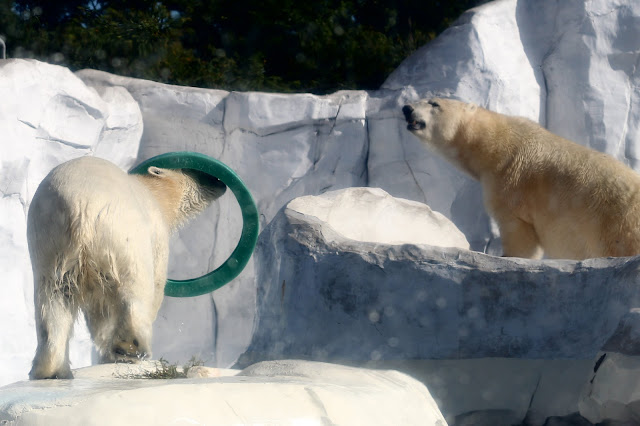
Astra on the bottom, plays with a ring,
 as mother Suka tries to steal it.


Astra is strong and can lift the ring every which way.

Seal tricks from Astra.


Look Mom! Astra shows off for her mother Suka.


Laerke, the weaker twin playing by herself,
struggles to lift the ring, but still has fun with it.

Laerke frames herself with a fun toy,
 one that Jebbie liked to play with too.


The girls are approaching their second birthday, to be celebrated on November 17. The plan, as I understand it, is that when Astra is weaned and separated from Suka, the girls may very well be reunited, and Laerke will again have a playmate.

Astra and Suka, sometimes together, often apart these days.

Mother Suka is gradually distancing herself from Astra, preparing for weaning, but right now, there is still some nursing going on.

It is the way of polar bear world that cubs leave to start life on their own at about the age of two in the wild. Then father Nuka can return from Toledo, and be reunited with Suka. 

Astra swimming in the viewing tunnel area.
 She can swim and play all day.


Laerke swims well enough, but she doesn't have the stamina of her sister, and she wants to go back inside after swimming for an hour.

Laerke is still a lot smaller than her sister, so reuniting the two may be put off for awhile.

This is pure speculation, but I hear that Point Defiance Zoo in Tacoma Washington, after the death of elderly bears Boris and Blizzard, is redoing its polar bear habitat, and will be home to some polar bears in 2023. Maybe that is where the twins will end up.